
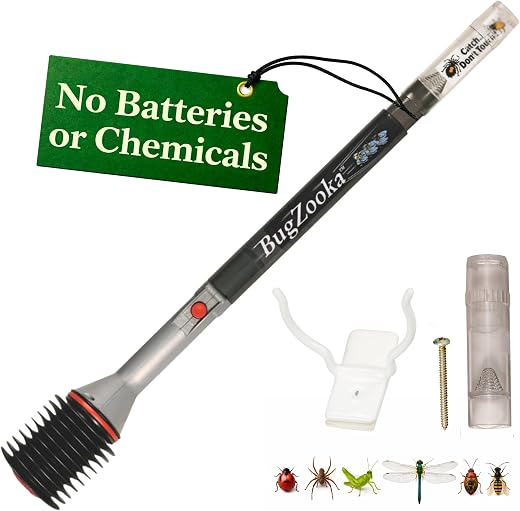




BugZooka WB100 Bug Vacuum with Long Nozzle
There are two ways to deal with a spider on a ceiling, and both are unsatisfying. A rolled magazine leaves a mark on the paint and a small death on your conscience; a glass and a postcard requires standing on furniture at full stretch with both hands occupied. The bug vacuum exists to provide a third option, and the BugZooka has been the best-known example for well over a decade. The no-battery design is genuinely clever and always ready, but the suction is a single burst and it is not strong enough for every insect.


| Price history for BugZooka Bug Vacuum with Long Nozzle, Humane Bug Catcher for All Ages | |
|---|---|
|
Latest updates:
|
|

$45.99
Description
BugZooka Bug Vacuum Review: Catch and Release Without Batteries
There are two ways to deal with a spider on a ceiling, and both are unsatisfying. A rolled magazine leaves a mark on the paint and a small death on your conscience; a glass and a postcard requires standing on furniture at full stretch with both hands occupied. The bug vacuum exists to provide a third option, and the BugZooka has been the best-known example for well over a decade.
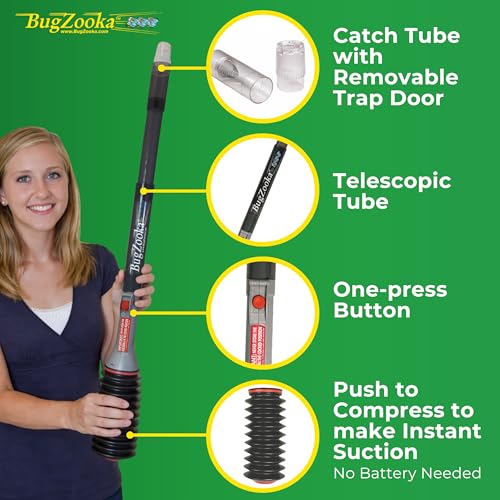
What sets it apart from the crowd of rechargeable insect vacuums that have appeared since is that it has no battery, no motor and no charging port. A spring-loaded bellows is compressed by hand and released by a trigger, producing an instant burst of suction through a long nozzle. It is mechanically simple to the point of being almost agricultural, and it sits on more than 5,000 ratings at a 4.1-star average.
Quick verdict: the BugZooka bug vacuum scores 7.3/10 in this SoftPickr review. the no-battery design is genuinely clever and always ready, but the suction is a single burst and it is not strong enough for every insect.
Table of Contents

Key Specifications
| Feature | Specification |
|---|---|
| Mechanism | Spring-loaded bellows, manual trigger |
| Power source | Air powered, no batteries or electricity |
| Reach | 17.75 in overall length |
| Dimensions | 5.25 x 3.75 x 17.75 in |
| Weight | 1.3 lb |
| Target species | Spiders, flies, mosquitoes, cockroaches, silverfish |
| Method | Catch and release, no chemicals |
| Materials | Moulded plastic |
| Model | WB100 |
| Manufacturer | Trimax |
| Warranty | Manufacturer warranty |
The Bellows Mechanism and What It Buys You
Compressing the bellows loads a spring; pulling the trigger releases it all at once, and the sudden volume change generates a short, sharp burst of suction at the nozzle. That burst is genuinely fast – much faster than a small battery fan can spin up – and speed is what actually catches insects, which react to air movement long before they react to the object producing it.
The advantage over battery rivals is not raw power but readiness. There is no charge to check, no motor to fail, no cell that has quietly gone flat since the last time you needed it in July. A tool kept in a utility cupboard for eight months works identically on the day it is grabbed, which for something used a handful of times a year is a far more useful property than an extra few pascals of suction.
Reach, Aim and the Ceiling Problem
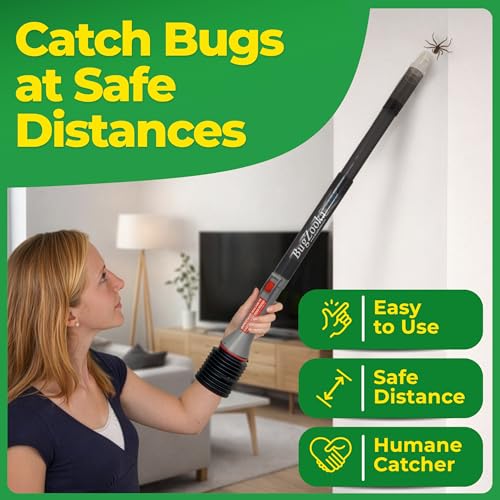
At just under eighteen inches long the BugZooka puts real distance between you and whatever you are catching, which is the entire point for anyone who is squeamish. Held overhead it covers a standard ceiling from the floor for most adults, and the long nozzle can be worked into a window frame corner or along a skirting board without your hand getting near the occupant.
Aim is where practice matters. The suction burst is short and directional, so the nozzle needs to be within an inch or so of the target and pointed properly before the trigger goes. A first attempt often misses; by the third or fourth insect most people have the knack. At 1.3 pounds it is light enough to hold steady overhead while lining up, which matters more than it sounds when you are stretched up a wall.
Catch, Release and the Case for Not Killing Things
The captured insect ends up in a clear chamber behind the nozzle, alive and generally unharmed. Walk to a door, point the nozzle outside and blow the chamber clear, and the animal goes back to the garden. For spiders, ladybirds, lacewings and praying mantises this is not sentimentality but sense – they are the things eating the pests you actually mind about, and killing them indoors is a small own goal.
It is also the option that works when chemicals are not wanted. No sprays, no residue on surfaces, nothing left behind in a kitchen or a nursery, which is why a noticeable share of buyers are households with small children or pets. The trigger action is simple enough that children can operate it themselves, and turning a frightening insect into a job with a tool does a lot for a nervous child.
Limitations and Compromises
The suction is one burst, and once released the bellows must be recompressed before another attempt. Against a fast-moving fly or a cockroach that has already spotted you, one attempt is often all you get, and the reload is slow enough that a missed shot usually means a lost insect. Battery vacuums that hold continuous suction are simply better at chasing something that is running.
Power is the other honest limitation and it explains the 4.1-star average directly. Large, heavy or well-anchored insects can hold on against the burst, and anything gripping a rough surface like brick or textured ceiling paint frequently stays put. The construction is also plainly plastic at a price of around forty-six dollars, which some buyers find hard to accept for a tool with no motor in it. There is a fair argument on both sides here: the mechanism is the value, not the material, and a moulded plastic bellows is exactly what a spring-loaded air pump should be made from. But a buyer holding it for the first time is comparing it against battery vacuums that cost less and feel more substantial, and the disappointment in that moment is real and is visible throughout the review record.
Care and Maintenance
Empty it every time rather than leaving an occupant in the chamber, which is both the humane approach and the way to avoid finding something desiccated in there next season. A quick blow-through outdoors clears most captures; for anything that leaves a mark, the chamber can be rinsed and dried thoroughly before the tool goes back in a cupboard.
The mechanism itself needs almost nothing, but the bellows should be stored uncompressed so the spring is not held under load for months at a time – that is the one habit that shortens its life. Keep the nozzle free of cobweb and dust, since a partially blocked tube dramatically reduces an already modest burst, and store it somewhere it will not be crushed. A tool that lives on a hook in a utility room stays usable for years; one that lives at the bottom of a box under garden equipment will have a deformed nozzle and a tired spring the next time it is needed.
Who Should Buy It?
- Households that would rather relocate insects than kill them.
- Anyone avoiding sprays and chemicals around children, pets or food preparation.
- People who are frightened of spiders and want distance rather than proximity.
- Buyers who want a tool that works after eight months in a cupboard with no charging.
- Parents teaching children to handle insects without fear or violence.
Look elsewhere if you are dealing with fast or numerous pests. A cockroach infestation or a fly problem needs a continuous-suction battery vacuum or, honestly, proper pest control rather than a catch-and-release tool. Anyone expecting a powerful vacuum will also be disappointed, because this is a single burst of air and it is deliberately modest.
SoftPickr Verdict
The BugZooka bug vacuum earns 7.3/10. The mechanical design is the best thing about it. No battery means no failure mode, and a tool used four times a year is exactly the kind that should not depend on a charge. The eighteen-inch reach, the humane clear chamber and the trigger action that a child can manage are all correctly judged, and it has held its place in this category for over a decade for good reason.
It gets no badge, and the 4.1-star average across more than 5,000 ratings says why: one burst of modest suction is not enough for every insect, the reload is slow, and the plastic construction is hard to square with the price. It is the right tool for a calm spider on a ceiling and the wrong one for anything quick.
Price and availability change frequently on Amazon, and prices shown here may be out of date — check the current listing before ordering.
BugZooka bug vacuum — Frequently Asked Questions
Does the BugZooka need batteries?
No. It is powered entirely by a hand-compressed spring-loaded bellows, so there is nothing to charge or replace. That is its main advantage over battery-powered insect vacuums, which are often flat when they are finally needed.
Does it kill the insect?
No. The insect ends up alive in a clear chamber behind the nozzle and can be released outdoors by blowing the chamber clear. That makes it useful for relocating beneficial insects such as ladybirds and praying mantises rather than killing them.
How strong is the suction?
Modest. It produces a single sharp burst rather than continuous suction, which is fast but limited. Large, heavy or firmly anchored insects can hold on against it, particularly on rough surfaces like brick or textured paint.
Can it reach a ceiling?
For most adults, yes. It is just under eighteen inches long, which covers a standard ceiling from the floor and lets you work into window corners without putting your hand near the insect.
Ready to buy? You can check the current price of the BugZooka bug vacuum on Amazon — the listing shows live pricing and current stock, both of which move around more than the specification does. SoftPickr earns a commission on qualifying purchases at no extra cost to you.
Related Reviews
If the BugZooka bug vacuum is not quite the right fit, these SoftPickr reviews cover the closest alternatives we have reviewed:
Additional information
Specification: BugZooka WB100 Bug Vacuum with Long Nozzle
|
Price History
| Price history for BugZooka Bug Vacuum with Long Nozzle, Humane Bug Catcher for All Ages | |
|---|---|
|
Latest updates:
|
|
There are no reviews yet.