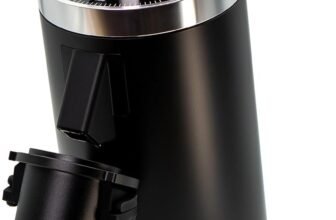
Short answer: buy the Fellow Opus 2 if anyone in your home makes espresso, or if you want one grinder for every brew method at half the price. Buy the Fellow Ode Gen 2 only if you brew filter coffee (pour-over, drip, French press, cold brew) and never pull shots, because Fellow states plainly that the Ode is “not suitable for espresso.” That single fact decides most Fellow Opus vs Ode questions before burr size or price even come up.
On 13 November 2026 the Opus 2 was $199.95 and the Ode Gen 2 was $399.95 on Amazon, both sold by Fellow and shipped by Amazon. This comparison is research-based: specifications come from Fellow’s own help center, the live Amazon listings checked on 13 November 2026 and the spec sheets of two US coffee retailers, each linked where it is used. We did not use these grinders ourselves.
Quick Picks
The Fellow Opus vs Ode choice in two lines:
- Best for espresso and “everything” households: Fellow Opus 2 — 48 mm conical burrs, stepless adjustment, an espresso catch cup for 54 mm and 58 mm portafilters. $199.95 on 13 November 2026.
- Best for filter-only drinkers: Fellow Ode Gen 2 — 64 mm flat burrs, 31 settings spread across brewed-coffee grinds, auto stop. $399.95 on 13 November 2026.
Fellow Opus vs Ode Spec Table: Opus 2 and Ode Gen 2
| Feature | Fellow Opus 2 | Fellow Ode Gen 2 |
|---|---|---|
| Built for | “Espresso to pour-over, French press, and cold brew” (Amazon listing) | “Pour-over, drip coffee, French press, and cold brew” — “Not for espresso” (Amazon listing) |
| Burrs | 48 mm conical, steel | 64 mm flat, “two-stage grinding geometry” |
| Adjustment | Stepless (moves continuously) | 31 stepped settings |
| Finest grind | Espresso fine | About 250–300 microns (Fellow help center; retailer) |
| Burr speed | Not published for the Opus 2 (the original Opus: 350 RPM) | 1,400 RPM (Fellow help center) |
| Load bin | Up to 100 g (retailers) | 100 g (Amazon listing; Fellow’s help page says 80 g) |
| Catch cups | Two magnetic cups: 100 g filter cup + 30 g espresso cup for 54 / 58 mm portafilters | One magnetic catch cup |
| Retention | “Near-zero” per Fellow: start with 22 g and “nearly all 22 grams make it out” | Anti-static technology, built-in knocker, optimized grind path |
| Auto stop | Yes | Yes |
| Size / weight | 8.1 × 5.1 × 10.5 in (Sweet Maria’s); 7.95 × 5.12 × 10.49 in (Amazon) | 9.9 lb (Amazon); 10.1 lb (Whole Latte Love) |
| Warranty | 2 years, extendable (listing) | 2 years, extendable (listing) |
| Amazon rating (13 Nov 2026) | 4.5 stars, 80 ratings | 3.9 stars, 729 ratings |
| Price (13 Nov 2026) | $199.95 | $399.95 |
Where two sources disagree we show both: the Ode Gen 2’s load bin is 100 g on the Amazon listing and on Whole Latte Love’s spec sheet, but 80 g on Fellow’s own comparison page. For a single cup (15–30 g) it makes no difference.
The One Question That Decides It: Espresso or Filter?
Fellow’s help article on the differences between Opus and Ode puts it in one line each: the Opus is “made to grind for all brew methods, from espresso to cold brew,” while the Ode is “built to dominate brewed coffee” and is “not suitable for espresso.” The Ode Gen 2’s finest grind is about 250–300 microns, according to Fellow and Whole Latte Love. Espresso needs a finer grind than that, which is why no amount of dial-turning makes the Ode an espresso grinder.
So the decision tree is short:
- You own an espresso machine, or might buy one in the next few years → Opus 2. The Ode cannot follow you there.
- You only brew pour-over, drip, AeroPress, French press or cold brew → either works; read the next two sections to choose.
- You want the cheaper grinder → Opus 2, by $200 on 13 November 2026.
If you are shopping for an espresso machine to go with the grinder, our espresso machines under $500 guide covers the beginner machines the Opus 2’s 54 mm and 58 mm portafilter cup is built around.
Burrs: 48 mm Conical vs 64 mm Flat
Burr geometry is the real hardware difference. The Opus 2 uses 48 mm conical burrs; the Ode Gen 2 uses larger 64 mm flat burrs with what Fellow calls a two-stage geometry. Fellow describes the cup each produces in its comparison chart: the original Opus as “high body, high sweetness, medium clarity,” and the Ode Gen 2 as “balanced, enhancing body and sweetness, medium clarity.” Fellow has not published a flavor chart for the Opus 2’s new 48 mm burrs, so treat the Opus line as a guide, not a measurement.
Two practical points are less subjective. First, burr speed: Fellow lists the Ode at 1,400 RPM and the original Opus at 350 RPM, and notes that slower conical burrs “generally means more consistency.” Second, range: conical burrs on the Opus 2 run from espresso to cold brew, while the Ode’s flat burrs are tuned only for brewed coffee. If you drink mostly light-roast pour-over and care about clarity, the flat-burr Ode is the grinder Fellow designed for you. If you drink medium or dark roasts, milk drinks, or a bit of everything, the Opus 2 makes more sense.
Adjustment: Stepless vs 31 Steps
The Opus 2’s biggest change from the first Opus is stepless adjustment. Fellow’s listing says it “moves continuously, so you can make tiny changes for espresso,” and both Whole Latte Love and Sweet Maria’s call it the main improvement over Gen 1. Stepless matters most for espresso, where a tiny grind change can move a shot by several seconds.
The Ode Gen 2 keeps 31 fixed settings, each spread across the filter range. For pour-over that is plenty: you find your setting for a given bean and brewer and return to it. A grind guide under the lid of each grinder gives starting points.
Workflow, Retention and Mess
Both are single-dose grinders: you weigh the beans for one brew, pour them in, press the button and walk away, because both stop on their own. Both use anti-static technology. Fellow claims “near-zero” retention for the Opus 2 (22 g in, nearly 22 g out); for the Ode Gen 2 it lists a built-in knocker and an optimized grind path rather than a number. Sweet Maria’s notes from a reviewer that the Opus 2 is not literally zero-retention, with an estimate of under a gram.
The Opus 2 ships with two magnetic catch cups: a 100 g cup for coarser grinds and a 30 g espresso cup that fits 54 mm and 58 mm portafilters, so you can grind straight into the basket. The Ode Gen 2 has one magnetic catch cup with pour fins. Either way, a coffee scale is the accessory that makes single dosing work, and our coffee ratio calculator tells you how many grams to weigh for each brew.
Noise and Counter Space
Whole Latte Love lists the Ode Gen 2 at about 60 dB, roughly a normal conversation, and Fellow’s listing calls it quieter grinding with a compact footprint that fits “under most cabinets.” The Opus 2 is 10.5 in tall by Sweet Maria’s figures, and a reviewer quoted there says its motor is not the quietest. Neither maker publishes a decibel figure for the Opus 2, so we can’t compare the two on equal terms. Measure the gap under your cabinets before ordering either.
Ratings and Track Record
On 13 November 2026 the Ode Gen 2 had 3.9 stars from 729 Amazon ratings, and the Opus 2 had 4.5 stars from 80 ratings. The Ode’s average is middling for a $400 grinder, so read recent reviews before buying. The Opus 2’s average is higher but built on far fewer ratings, so its long-term record is shorter. Both carry a 2-year warranty from Fellow with the option to extend, stated on each listing.
Total Cost
A grinder alone doesn’t brew coffee. For the Opus 2 used for espresso, budget the grinder ($199.95 on 13 November 2026) plus a machine, a scale and a tamper. For the Ode Gen 2, budget the grinder ($399.95) plus a scale and a gooseneck kettle for pour-over. On the filter side, the Opus 2 route leaves about $200 for those extras; the Ode route spends it on the grinder.
What About the Original Opus and the Ode Gen 1?
Fellow’s help page compares the original Opus (40 mm conical burrs, 41+ settings, 350 RPM) with both Ode generations. The Ode Gen 1 also has 64 mm flat burrs and 31 settings, but Fellow says it grinds only from 500 microns up, so the Gen 2 reaches finer filter grinds such as AeroPress and V60. If you see an older Opus or an Ode Gen 1 cheaply, those are the differences to weigh; the current listings above are the Opus 2 and the Ode Gen 2.
Alternatives If Neither Fits
- Flat burrs and espresso in one grinder: the MiiCoffee DF64 II pairs 64 mm flat burrs with espresso range. See every option in our single dose coffee grinder roundup.
- No counter space or no outlet: a hand grinder such as the 1Zpresso K-Ultra covers filter and espresso. Compare them in our manual coffee grinder guide.
Fellow Opus vs Ode: Which Should You Buy?
Buy the Fellow Opus 2 if:
- you make espresso now or might later
- different people in your home brew different ways
- you want stepless adjustment and a portafilter-ready catch cup
- you want to spend about $200, not $400
Buy the Fellow Ode Gen 2 if:
- you only brew filter coffee and never will make espresso
- you want 64 mm flat burrs, the burr type Fellow built for brewed coffee
- you want a lower, quieter grinder (about 60 dB per Whole Latte Love) that fits under cabinets
- you are fine paying $399.95 for a specialist and reading recent reviews first
Check the current price of the Fellow Opus 2 on Amazon · Check the current price of the Fellow Ode Gen 2 on Amazon
Black Friday Deal Watch (27–30 November 2026)
Both grinders were at their usual prices on 13 November 2026 ($199.95 and $399.95), with no list-price discount shown. Fellow grinders do not always join Black Friday sales, so if you see either below those figures between 27 and 30 November 2026, that is a real discount. Check the Amazon listing on the day; prices change without notice.
Frequently Asked Questions
Can the Fellow Ode Gen 2 grind for espresso?
No. Fellow says the Ode is “not suitable for espresso,” and the Amazon listing reads “Designed specifically for brewed coffee. Not for espresso.” Its finest setting is about 250–300 microns, which is too coarse for an espresso shot.
Is the Fellow Opus 2 good for pour-over?
Yes. Fellow lists pour-over, French press and cold brew alongside espresso, and the Opus 2 ships with a 100 g catch cup for coarser grinds. Filter purists who want flat burrs and maximum clarity tend to prefer the Ode, but the Opus 2 covers pour-over.
What is the difference between Fellow Opus vs Ode in one sentence?
The Opus 2 is a $199.95 all-rounder with 48 mm conical burrs that grinds from espresso to cold brew; the Ode Gen 2 is a $399.95 filter-only grinder with 64 mm flat burrs (prices on 13 November 2026).
Which has more grind settings?
The Opus 2 is stepless, so it has no fixed number of settings. The original Opus had 41+ settings and the Ode Gen 2 has 31.
Is the Ode Gen 2 worth twice the price of the Opus 2?
Only for filter-only drinkers who want flat burrs. For anyone who makes espresso, it isn’t, because the Ode can’t grind for it. Its 3.9-star Amazon rating from 729 ratings (13 November 2026) is also lower than the Opus 2’s 4.5 stars, though the Opus 2 has far fewer ratings.
Which is quieter, the Fellow Opus or Ode?
Whole Latte Love lists the Ode Gen 2 at about 60 dB. Fellow does not publish a decibel figure for the Opus 2, and a reviewer quoted by Sweet Maria’s calls its motor not the quietest, so the Ode is the safer bet if noise matters.
What about the Ode Gen 1 vs Gen 2?
Both have 64 mm flat burrs and 31 settings, but Fellow says the Gen 1 grinds from 500 microns up and the Gen 2 from about 250–300 microns, so the Gen 2 reaches finer filter grinds.
Verdict
For most homes, the Fellow Opus 2 is the better buy: it costs half as much, covers espresso, and adds stepless adjustment and a portafilter catch cup. The Fellow Ode Gen 2 earns its price only on a filter-only counter, where its 64 mm flat burrs are exactly what Fellow built it for. Read our full Opus 2 review and Ode Gen 2 review, or compare them with six other grinders in the single dose coffee grinder roundup.
How We Compared
This Fellow Opus vs Ode comparison is research-based. We read both live Amazon listings on 13 November 2026 for price, seller, stock and ratings; took design intent, burr speed, grind range and capacity from Fellow’s help center; and filled gaps from the spec sheets of Whole Latte Love and Sweet Maria’s, named wherever they are used. We did not use these grinders ourselves, and we say where sources disagree.
Affiliate disclosure: SoftPickr earns a commission from qualifying Amazon purchases made through links on this page, at no extra cost to you. It does not change which grinder we recommend.