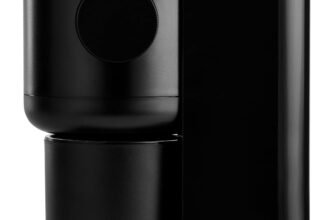
Short answer: buy the MiiCoffee DF64 II if espresso is your main drink and you may want to swap burrs later, because it has bigger 64 mm flat burrs, a stronger motor and a listed SSP burr upgrade path. Buy the MiiCoffee DF54 if you want the same single-dose workflow for $170 less, on a smaller footprint, and you can live with a slower grind and a weaker review score. Most DF64 vs DF54 decisions come down to that trade: burr size and upgrade room against price and counter space.
On 21 November 2026, Amazon’s product data showed the DF64 II at $399.00 and the DF54 at $229.00, both in stock. This comparison is research-based: specifications come from the two live Amazon listings, a US dealer’s DF54 spec page and a Canadian retailer’s DF64 vs DF54 write-up, each linked where it is used. We did not use these grinders ourselves.
Quick Picks
- Best for espresso and future upgrades: MiiCoffee DF64 II — 64 mm stainless steel flat burrs, stepless dial, aluminum 58 mm dosing cup, SSP-upgradable per the listing. $399.00 (read from Amazon’s product data on 21 November 2026).
- Best value and smaller kitchens: MiiCoffee DF54 — 54 mm stainless steel flat burrs, stepless dial, plastic 58 mm dosing cup, about 4.7 kg. $229.00 (read from Amazon’s product data on 21 November 2026).
Both appear in our single dose coffee grinder roundup, where the DF64 II is the overall pick and the DF54 is the value pick.
DF64 vs DF54 Spec Table
| Feature | MiiCoffee DF64 II | MiiCoffee DF54 |
|---|---|---|
| Price (21 Nov 2026, Amazon) | $399.00 | $229.00 |
| Version on the Amazon listing | 2.6 | 1.5 |
| Burrs | 64 mm stainless steel flat, “upgradable to SSP burrs” (listing) | 54 mm stainless steel flat (listing); no upgrade burrs named |
| Motor | 250 W AC (DF64 Coffee comparison table) | 150 W AC, 1,400 RPM (DF64 Coffee spec page) |
| Grind speed | “Faster” (DF64 Coffee) | “Slow” (DF64 Coffee) |
| Adjustment | Stepless dial with chrome wrap and metal indicator | Stepless dial with chrome wrap and metal indicator |
| Retention claim | “True Zero Retention” (maker’s claim) | “True Zero Retention”, under 0.1 g (maker’s claim) |
| Static control | Plasma generator probes around the inner chute | Plasma generator around the exit chute |
| Dosing cup | 58 mm aluminum | 58 mm transparent plastic |
| Bean load | Not stated on the listing | 20 g without bellows, 50 g with (DF64 Coffee) |
| Size | 25 × 13 × 30 cm (Amazon listing) | 17.8 × 11.4 × 30.5 cm (DF64 Coffee) |
| Weight | 15 lb (Amazon listing) | About 10 lb / 4.7 kg (listing; DF64 Coffee) |
| Voltage (US listing) | 110 V US plug | 100–120 V (US version) |
| Warranty | One year (Amazon listing details) | One year (DF64 Coffee; not stated on Amazon) |
| Amazon rating (18 Oct 2026) | 4.4 out of 5 | 3.8 out of 5 |
Where a cell names DF64 Coffee, the figure comes from the DF64 Coffee DF54 product page, a US dealer selling the same model names; the Amazon listings do not publish motor power or burr speed. No source we found states a burr speed for the DF64 II, so we leave it blank rather than guess.
The Question That Decides It: How Much Espresso Do You Make?
Both grinders are flat-burr, single-dose, stepless machines that their sellers describe for espresso and filter coffee alike. Neither is a filter-only grinder, so the DF64 vs DF54 question is not “espresso or pour-over” the way it is with some pairs. It is how often you grind, and how much you care about burr choice.
If you pull two or three shots a day, the DF64 II’s larger burrs and 250 W motor matter every morning: DF64 Coffee rates its grind speed “faster” and the DF54’s “slow.” If you make one shot or one pour-over a day, a slower grind costs you seconds, and the $170 saved buys a scale, a tamper and a puck screen with money left over.
The second question is upgrades. The DF64 II listing names SSP burrs as an option, and 64 mm is a common flat-burr size, so there is room to change the grinder’s taste profile later. The DF54 listing names no upgrade burrs at all. If you think you will chase lighter roasts or brew-specific burrs in a year, that one line favors the DF64 II.
Burrs: 64 mm vs 54 mm Flat
Both grinders use custom-made stainless steel flat burrs. The DF64 II’s are 64 mm; the DF54’s are 54 mm. A larger flat burr has more cutting surface, which is one reason the bigger grinder finishes a dose sooner. Coffee Addicts, a Canadian retailer, sums up the gap in its DF64 and DF54 comparison as better grind speed and more burr options for the DF64, and lower noise and price for the DF54.
Taste differences between burr sizes are argued over on every coffee forum. We do not claim one makes “better” espresso; makers and retailers describe both as espresso-capable, and burr geometry and alignment matter as much as diameter. For the wider flat-versus-conical question, our single dose coffee grinder guide explains what each burr type is usually chosen for.
Motor, Speed and Noise
DF64 Coffee’s spec page lists the DF54 with a 150 W AC motor at 1,400 RPM and the DF64 II with a 250 W AC motor. Neither Amazon listing states motor figures. More motor power with bigger burrs is why the DF64 II is described as the faster grinder.
The flip side is noise: Coffee Addicts describes the DF54 as the quieter of the two and the DF64 as louder, which fits a smaller motor. If you grind at 6 a.m. in an apartment, that is a fair reason to lean DF54. Neither seller publishes a decibel figure, so treat this as a relative difference, not a measured one.
Workflow, Retention and Static
Day to day, the two grinders work the same way. You weigh beans, drop them in, grind into the 58 mm dosing cup, and use the bellows to clear what is left in the chute. Both listings claim “True Zero Retention” and both include an anti-popcorn disc that stops beans bouncing out of the throat. Treat zero retention as the maker’s claim; in practice, the bellows step is what gets you close to it.
Both have a plasma generator (ionizer) to cut static. On the DF64 II the probes wrap around the inner chute (the listing says this changed with version 2.5); on the DF54 the generator wraps around the exit chute. The DF54’s listing also says version 1.4 brought an enlarged chute and an upgraded metal declumper, and version 1.5 a larger anti-popcorn disc. Searches for “DF54 clogging” are common, so check which version a seller is shipping before you buy; the version on the Amazon listing on 21 November was 1.5.
The dosing cups differ in material. The DF64 II ships with an aluminum cup and the DF54 with a transparent plastic one. Both are 58 mm, and both listings advise using the cup rather than grinding straight into the portafilter if your portafilter isn’t 58 mm, which matters for Breville’s 54 mm machines.
DF64 vs DF54 Size and Counter Space
Both grinders stand about 30 cm tall, so either fits under most wall cabinets. The difference is footprint and weight. DF64 Coffee lists the DF54 at 17.8 cm deep and 11.4 cm wide, about 4.7 kg; the DF64 II’s Amazon listing gives 25 × 13 × 30 cm and 15 lb. If your espresso machine already takes most of the counter, the DF54’s narrower body is the easier fit.
Ratings and Track Record
On 18 October 2026, the DF64 II’s Amazon listing showed 4.4 out of 5 stars and the DF54’s showed 3.8, the lowest of the main picks in our grinder roundup. A lower score does not tell you why, so read the newest one- and two-star reviews before buying and note whether they describe an older version. Both are sold with a one-year warranty according to the sources above; confirm the term with the seller, because the DF54’s Amazon listing does not state one.
Who Makes Them? MiiCoffee, Turin and DF64 Coffee Names
You will see the same model names under different store brands. The Amazon listings we link say MiiCoffee; US dealer sites sell DF54 and DF64 grinders under names such as DF64 Coffee and Turin, and some sellers number versions differently. The model number (DF54, DF64 II / Gen 2) tells you the burr size; the version number on the listing tells you which revision you will get. Compare versions, voltage and warranty rather than the brand name on the box.
Total Cost
Neither grinder is the whole bill. Budget for:
- A scale: single dosing means weighing every dose. Our coffee scale guide covers espresso scales that fit on a drip tray.
- A puck screen or tamper upgrade (optional): see our espresso puck screen and espresso tamper roundups.
- SSP burrs (DF64 II only, optional): a later upgrade the listing names; price them separately before you count on it.
On 21 November, the $170 gap between the two was enough to fund a scale and puck-prep tools. That is the real argument for the smaller grinder.
DF64 II vs TIMEMORE Sculptor 064S
Readers comparing the DF64 II often look at the TIMEMORE Sculptor 064S as the next step up. Its listing describes a brushless motor with adjustable 800–1,200 RPM and a rotary knocker to clear fines, which neither DF model offers. On 21 November, Amazon’s product data showed no available offer for the Sculptor 064S (it was $599.00 on 18 October), so check its page before planning around it. If you want variable speed, it is the one to watch; if you want a 64 mm flat burr at a lower price today, the DF64 II is the available choice.
Alternatives If Neither Fits
- Want conical burrs and a smaller price: the Fellow Opus 2, covered in our Fellow Opus vs Ode comparison.
- Don’t want a plug at all: our manual coffee grinder roundup.
- Still choosing the machine: start with our espresso machine under $500 or espresso machine under $1,000 guides, then match the grinder.
DF64 vs DF54: Which Should You Buy?
Buy the DF64 II if: you make espresso most days, you want the faster grind, you like the idea of SSP burrs later, or you value the aluminum cup and higher review score.
Buy the DF54 if: you make one or two drinks a day, counter space is tight, a quieter motor matters, or the $170 is better spent on a scale and puck prep tools.
Check the current price of the DF64 II on Amazon · Check the current price of the DF54 on Amazon
Black Friday Deal Watch (27–30 November 2026)
- DF64 II: $399.00 on 21 November 2026, the same price as on 18 October; Amazon showed no list-price markdown. Full DF64 II review.
- DF54: $229.00 on 21 November 2026, unchanged since 18 October. DF64 Coffee’s own site showed it at $230 (regular $260) on the same day. Full DF54 review.
- What to look for: a drop that narrows the gap below about $120 makes the DF64 II the easier call; a DF54 under $200 makes it hard to beat as a first flat-burr grinder. Check the listing’s version number before buying a discounted unit.
Frequently Asked Questions
Is the DF54 good for espresso?
Its listing says its stepless dial “can be dialed in for espresso with high precision,” and dealers describe it for both espresso and filter. Its weaker points are a slower grind and a lower review score, not espresso range.
Is the DF64 louder than the DF54?
Retailer write-ups describe the DF64 as louder and the DF54 as quieter, consistent with the DF64 II’s 250 W motor versus the DF54’s 150 W. Neither seller publishes decibel figures.
Which is better for pour-over?
Both are sold for filter coffee as well as espresso. The DF64 II has the wider burr upgrade path if you want brew-focused burrs later; for pour-over only, a filter-focused grinder such as the Fellow Ode Gen 2 is worth a look in our Opus vs Ode comparison.
Can you upgrade the DF54 burrs?
The DF54’s Amazon listing does not name any upgrade burrs, while the DF64 II’s listing names SSP burrs. Ask the seller before buying if burr swaps matter to you.
What is the size difference between the DF54 and DF64?
Both are about 30 cm tall. The DF54 is narrower and lighter (17.8 × 11.4 cm, about 4.7 kg per DF64 Coffee); the DF64 II is 25 × 13 cm and 15 lb per its Amazon listing.
Is the Turin DF54 the same as the MiiCoffee DF54?
Sellers use different store names for DF54 and DF64 models. Compare the version number, voltage and warranty each seller lists rather than relying on the brand name.
Is the DF64 II worth $170 more than the DF54?
For daily espresso and anyone planning burr upgrades, yes on paper: faster grinding, bigger burrs and a higher review score. For light use on a small counter, the DF54 does the same job for less.
Verdict
The DF64 II is the better long-term grinder: 64 mm burrs, a stronger motor, an aluminum cup, a listed SSP upgrade and a better review score. The DF54 is the better value if you grind once or twice a day, want something smaller and quieter, and would rather spend the difference on a scale. Read our full DF64 II review and DF54 review, or compare them with six other grinders in the single dose coffee grinder roundup.
How We Compared
This DF64 vs DF54 comparison is research-based. We read prices and stock from Amazon’s product data on 21 November 2026; burr, adjustment, retention, cup and version details from both Amazon listings; motor, speed, size and bean-load figures from the DF64 Coffee DF54 page; and the noise and speed comparison from Coffee Addicts. Star ratings are from our 18 October 2026 listing check. We did not use these grinders ourselves, and we say where a figure is missing rather than estimate it.
Affiliate disclosure: SoftPickr earns a commission from qualifying Amazon purchases made through links on this page, at no extra cost to you. It does not change which grinder we recommend.