

SolCook Solar Cooker Review — Can You Really Cook a Meal With Sunlight?
Solar cooking sits in an awkward place between serious off-grid equipment and novelty. The physics is straightforward, a reflective panel concentrates sunlight onto a dark vessel and the vessel gets hot, but the marketing around the category has a long history of promising campfire results from a folded sheet of cardboard. The SolCook All Season is the version that keeps getting recommended by people who actually cook outdoors. A genuinely capable panel cooker that will only ever be as good as the sky above it.


| Price history for SolCook All Season Solar Cooker - Camping Cookware, Fruit & Food Dehydrator, Camp Stove, Fruit Canning Supplies, Camping Gear, Survival Gear, Emergency Supplies, (17) Camper | |
|---|---|
|
Latest updates:
|
|

$89.00
Description
SolCook Solar Cooker Review: Cooking With Nothing but Sunlight
Solar cooking sits in an awkward place between serious off-grid equipment and novelty. The physics is straightforward, a reflective panel concentrates sunlight onto a dark vessel and the vessel gets hot, but the marketing around the category has a long history of promising campfire results from a folded sheet of cardboard. The SolCook All Season is the version that keeps getting recommended by people who actually cook outdoors.
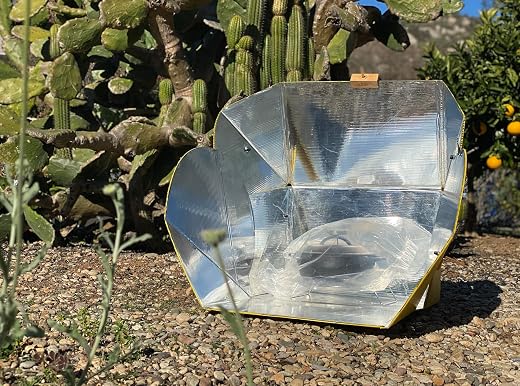
It is a four-pound folding panel that costs $89, doubles as a food dehydrator, and holds a 4.5-star average across 501 ratings. That is a modest evidence base by our usual standards, and the honest framing of this review is that we are assessing a well-made example of a technology with hard physical limits rather than asking whether it beats a camp stove. It does not, and it is not trying to.
Quick verdict: the SolCook solar cooker scores 7.5/10 in this SoftPickr review. A genuinely capable panel cooker that will only ever be as good as the sky above it.
Table of Contents

Key Specifications
| Feature | Specification |
|---|---|
| Type | Folding panel solar cooker and dehydrator |
| Power source | Direct sunlight, no fuel or electricity |
| Rated output | Up to 1.5 kW of collected energy |
| Deployed size | 28 x 28 x 28 in |
| Weight | 4 lb |
| Construction | Polypropylene fluteboard with UV-protected reflective film |
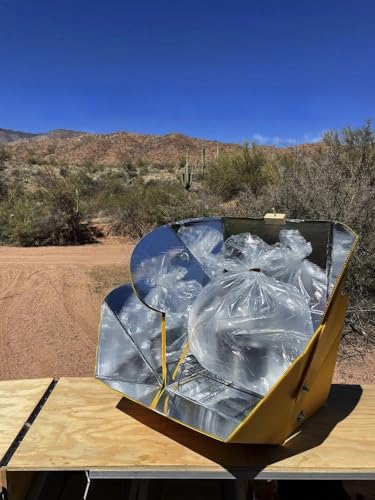
| Included | Cooking rack and reusable cooking bags |
| Daylight use | Designed to use up to 12 hours of available sun |
What It Can and Cannot Cook
A panel cooker of this size operates in the range where slow, moist cooking works and searing does not. Soups, stews, beans, rice, root vegetables, chicken pieces, bread and eggs all cook properly given the hours, and the results are closer to a slow cooker than an oven. Anything needing a hard sear, a hot crust or a rapid boil is outside what a panel design can deliver.
Time is the currency. A pot of beans that takes ninety minutes on gas is a four to six hour proposition here, and that is with good sun. The upside is that solar cooking is almost impossible to burn, since the collector plateaus rather than climbing, so you can leave food unattended in a way you never could over a flame. Treat it as a set-and-forget appliance rather than a stove and it starts to make sense.
The Sun Is the Specification
Every meaningful variable is outside your control. Direct, unobstructed sunlight is required, which means a clear sky, a spot with no tree or roof shadow crossing it during the cook, and a session timed around solar noon rather than dinner time. Thin high cloud slows the cook noticeably and thick cloud stops it entirely, with no partial credit.
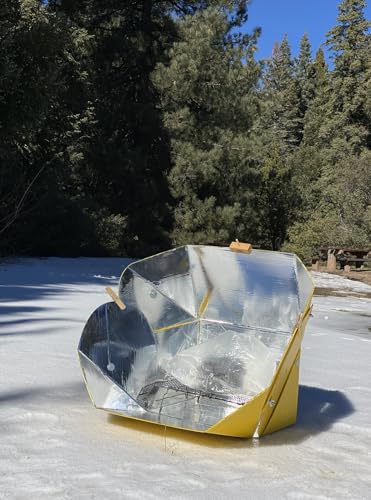
You also have to reposition the panel roughly every thirty minutes to track the sun, or accept a much longer cook. That is a small chore, but it means solar cooking is not compatible with leaving camp for the day. The “All Season” name refers to the panel geometry working at lower winter sun angles rather than to any claim about cooking through overcast weather, and it is worth reading it that way.
Dehydrating and the Preparedness Case
The dehydrator function is the part of this product that gets the least attention and may be the most useful. The same panel and rack, run at a lower temperature with the bags open, dries fruit, herbs and vegetables over a day of sun, and SolCook claims it does so faster than an electric dehydrator. For anyone with a productive garden and more courgettes than sense in August, that is a genuinely practical use that does not depend on cooking a meal to a deadline.
The emergency case is real but should be stated carefully. In a power outage this cooks food using no fuel you have to store, which is a meaningful advantage over a camp stove with finite gas canisters. It is also completely useless at night, in winter storms and during exactly the kind of prolonged overcast weather that often accompanies a serious outage. It belongs in a preparedness kit alongside a fuel stove, not instead of one.
Limitations and Compromises
The fundamental limitation is that this is a weather-dependent appliance, and no amount of good engineering changes that. A cloudy week means a cooker that does nothing at all, and the cook times even in perfect conditions are measured in hours. Anyone imagining they will make dinner on a whim will use it twice and then leave it in the garage.
The build is light and functional rather than robust. Polypropylene fluteboard is essentially a rigid plastic corrugate, chosen because it is four pounds instead of twenty, and it will not survive being sat on, blown across a campsite untethered or repeatedly packed wet. It needs weighting or pegging in any breeze, and the reflective film is the surface that determines performance and the surface most easily scratched.
Care and Setup Tips
The reflective film is the whole product. Clean it only with a soft damp cloth and never with an abrasive, a solvent or a paper towel, since fine scratching scatters the light that the panel is supposed to be concentrating and the loss is permanent. Keep the panel out of sand and grit when folding, and store it flat rather than leaning where the corners can crease.
Use the supplied bags and a dark, thin-walled vessel rather than a heavy cast pot, which absorbs so much energy heating itself that the food never gets there. Site the cooker on a surface that does not shade it during the session, weight or peg the panel in any wind, and check the alignment every half hour. If a cook is running long as the afternoon shortens, move the food to a conventional heat source rather than leaving it in the danger zone below simmering temperature.
Who Should Buy It?
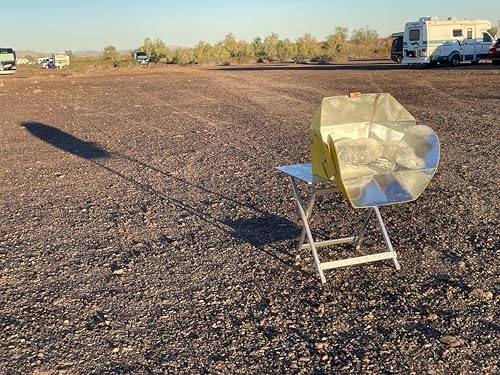
- Campers and van dwellers who want fuel-free cooking on sunny trips.
- Gardeners with a glut of produce who want a free, high-capacity dehydrator.
- Anyone building a preparedness kit that does not depend on stored fuel.
- People in consistently sunny climates who cook slow, moist dishes.
- Anyone wanting to cook outdoors where open flames are prohibited by fire restrictions.
Look elsewhere if you live somewhere with unreliable sun, because a cooker that does nothing on a cloudy day is not a cooker you will use, and in a temperate maritime climate that is most of the year. Look elsewhere too if you need food at a particular time: cook times here run to four hours or more and depend on solar noon rather than your schedule, so a camp stove or a fuel canister remains the right answer for making dinner. And treat this as an addition to a preparedness kit rather than a replacement for a fuel stove, since serious outages often coincide with exactly the weather that makes solar cooking impossible.
SoftPickr Verdict
The SolCook solar cooker earns 7.5/10. It is a well-made example of the technology, light enough to actually take somewhere at four pounds, versatile enough to double as a serious dehydrator, and it does genuinely cook real food using nothing but sunlight.
The compromise is total dependence on the weather. Cook times run to hours, the panel needs repositioning every half hour, and a cloudy day means no cooking at all, so this earns its place as a second cooking method in a sunny climate rather than a primary one anywhere.
Price and availability change frequently on Amazon, and prices shown here may be out of date — check the current listing before ordering.
SolCook solar cooker — Frequently Asked Questions
How long does the SolCook solar cooker take to cook a meal?
Expect four to six hours for beans, stews or root vegetables in good direct sun, and less for eggs or reheating. Cook times stretch further under thin cloud and stop entirely under thick cloud, so plan sessions around solar noon rather than mealtimes.
Does it work in winter or on cloudy days?
The All Season geometry is designed for the lower sun angles of winter and works on clear cold days. It does not work under thick cloud at all, because there is no diffuse-light mode: the panel concentrates direct sunlight and needs the sun to be visible.
Can it be used as a food dehydrator?
Yes, and it is one of its stronger uses. Running the panel with the rack and open bags dries fruit, herbs and vegetables over a day of sun, which suits anyone preserving a garden harvest without adding to an electricity bill.
What cookware should be used with it?
Dark, thin-walled vessels and the supplied reusable bags. Heavy cast iron absorbs too much of the collected energy heating itself, so the food never reaches temperature. Lightweight dark metal or the bags themselves give much better results.
Ready to buy? You can check the current price of the SolCook solar cooker on Amazon — the listing shows live pricing and current stock, both of which move around more than the specification does. SoftPickr earns a commission on qualifying purchases at no extra cost to you.
Related Reviews
If the SolCook solar cooker is not quite the right fit, these SoftPickr reviews cover the closest alternatives we have reviewed:
Additional information
Specification: SolCook Solar Cooker Review — Can You Really Cook a Meal With Sunlight?
|
Price History
| Price history for SolCook All Season Solar Cooker - Camping Cookware, Fruit & Food Dehydrator, Camp Stove, Fruit Canning Supplies, Camping Gear, Survival Gear, Emergency Supplies, (17) Camper | |
|---|---|
|
Latest updates:
|
|

There are no reviews yet.