
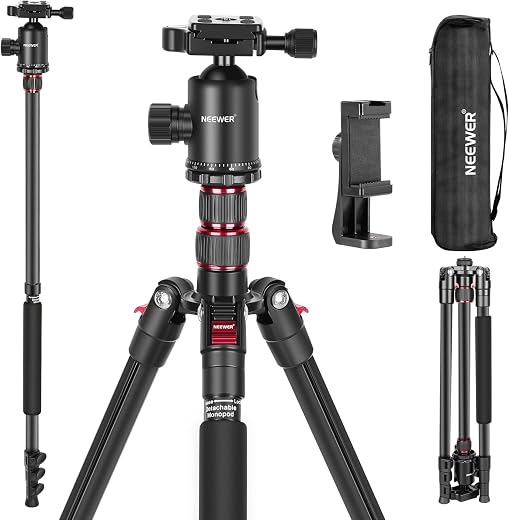


NEEWER TP77 Camera Tripod — 77 In Aluminium, Ball Head, Monopod Conversion
A tripod is the accessory photographers buy last and should buy first. Every long exposure, every landscape at dusk, every product shot and every piece of video shot alone depends on the camera not moving, and no amount of stabilisation in a lens or a body substitutes for a stable platform. The problem is that good tripods have always cost more than the lens people would rather buy. It is a lot of usable tripod for the money and the right first tripod for most people, with the honest compromise that four-section aluminium legs are not the steadiest platform in wind.
| Price history for NEEWER 77 Inch Camera Tripod Monopod for DSLR & Phone, Aluminum, TP77 | |
|---|---|
|
Latest updates:
|
|

$67.99
Description
NEEWER Camera Tripod Review — Seventy-Seven Inches for Fifty-Five Dollars
A tripod is the accessory photographers buy last and should buy first. Every long exposure, every landscape at dusk, every product shot and every piece of video shot alone depends on the camera not moving, and no amount of stabilisation in a lens or a body substitutes for a stable platform. The problem is that good tripods have always cost more than the lens people would rather buy.
The NEEWER TP77 is the answer at the accessible end: aluminium rather than carbon fibre, a full 77 inches of height, a ball head included, and a leg that unscrews to become a monopod. It holds 4.6 stars across more than 1,800 ratings. We looked at what the numbers on the specification sheet mean in practice, and where aluminium at this price shows its limits.
Quick verdict: the NEEWER camera tripod scores 8.3/10 in this SoftPickr review. It is a lot of usable tripod for the money and the right first tripod for most people, with the honest compromise that four-section aluminium legs are not the steadiest platform in wind.
Table of Contents
- Key Specifications
- Height Matters More Than Photographers Expect
- The Ball Head and the Quick Release Plate
- Load Rating, Weight and the Monopod Trick
- Reading the Rest of the Specification Sheet
- Limitations and Compromises
- Leg Locks, Grit and Field Care
- Who Should Buy It?
- SoftPickr Verdict
- Frequently Asked Questions
- Related Reviews

Key Specifications
| Feature | Specification |
|---|---|
| Model | TP77 |
| Maximum height | 77 in (195.6 cm) |
| Minimum height | 19 in |
| Folded length | 19 in |
| Leg sections | 4 |
| Leg diameter | 36 mm at the top section |
| Load capacity | 34 lb |
| Weight | 3.1 lb |
| Head | Ball head with quick release plate |
| Monopod conversion | Yes — one leg detaches |
| Material | Aluminium with rubber grips |
| Warranty | 1 year manufacturer |
Height Matters More Than Photographers Expect
Seventy-seven inches is unusually tall for a tripod at this price, and height is worth more than it sounds. A tripod that reaches only to chest level forces the photographer to stoop for every shot, which is tiring across a day and genuinely limiting when the subject is above eye level. Full extension here puts the viewfinder above the head of an average adult.
It also matters for video and for shooting over obstacles — a crowd, a fence, a hedge at the edge of a field. The centre column contributes some of that reach, and as always the last section of centre column is the least stable part of any tripod, so the useful working height with maximum stability is somewhat below the headline figure. That is true of every tripod ever made.
The Ball Head and the Quick Release Plate
A ball head is the right choice for stills. One control loosens the ball, the camera moves freely in every direction at once, and one tightening motion locks it. Compared with a three-way pan-tilt head, framing a shot takes seconds rather than three separate adjustments, and for landscape and travel work that speed is the difference between catching light and missing it.
The quick release plate stays on the camera between uses, which means mounting is a single click rather than a thirty-second screw thread. Plate systems are proprietary rather than standardised at this end of the market, so a spare plate is a sensible few dollars to keep in the bag — losing the only one renders the tripod temporarily useless.
Load Rating, Weight and the Monopod Trick
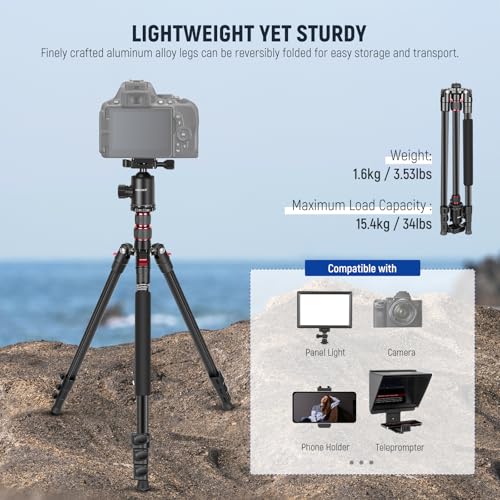
A 34 pound load rating is far beyond anything a mirrorless or DSLR body with a normal lens will ever weigh, and the headroom is genuinely useful. Load ratings assume a balanced, static load, and a long telephoto lens hanging off the front of a body creates leverage that a marginal rating handles poorly. Substantial headroom means the head does not creep under an unbalanced setup.
Detaching one leg to form a monopod is a real feature rather than a gimmick. A monopod supports weight and removes vertical shake while allowing quick repositioning, which is what wildlife, sports and event photographers actually need when a tripod is too slow and handheld is too shaky. Getting both in one 3.1 pound package is the strongest argument for this model.
Reading the Rest of the Specification Sheet
This listing carries a number of fields that belong to a camera rather than a tripod — shutter speed ranges, a video capture format of MP4, exposure control and a screen size. They are template artifacts and describe nothing about the product. It is worth noticing, because a listing that reports its own category incorrectly is a listing to read carefully.
The fields that do describe the tripod are internally consistent and match the physical product: 77 inch maximum height, 19 inch folded length, four leg sections, 36 mm top leg diameter, 34 pound capacity and 3.1 pound weight. Those are the figures this review relies on, and they describe a competent aluminium travel tripod at a competitive price.
Limitations and Compromises
Four leg sections is the compromise that buys the short 19 inch folded length, and it costs stability. Each additional section means another set of locks and a thinner bottom tube, and the narrowest section is the one carrying everything above it. Fully extended in wind, this tripod will transmit more vibration than a three-section design, and the bottom section is best left retracted whenever the height is not needed.
Aluminium rather than carbon fibre means more weight for the same rigidity, and it means the legs conduct cold. At 3.1 pounds it is not heavy by any reasonable standard, but a carbon equivalent would be closer to two, and in freezing conditions bare hands on aluminium legs is genuinely unpleasant. Leg wraps solve the second problem for a few dollars.
The listing specification is unreliable, carrying camera fields that have nothing to do with a tripod, and the warranty is one year. The head is also not separately upgradeable in the way a modular system allows, so a photographer who outgrows the ball head is buying a whole new tripod rather than a better head.
Leg Locks, Grit and Field Care
Grit in the leg locks is what kills tripods, and beaches and riverbanks are where it gets in. After any sandy or muddy outing, extend every section fully, rinse the lower legs in clean fresh water, and let them dry extended before collapsing them. Salt water in particular should never be allowed to dry inside a leg section.
Twist locks loosen over months of use and can be retightened by hand or with a small tool; a leg that slips under load almost always needs tightening rather than replacing. Keep the ball head clean and unlubricated — oil attracts dust and turns a smooth head gritty — and store the tripod with the legs collapsed but the locks loose to avoid stressing the mechanisms.
Who Should Buy It?
- You are buying your first proper tripod and want height, a ball head and a monopod in one.
- You shoot landscapes, long exposures or video where camera shake is the limiting factor.
- You want a folded length short enough to strap to a daypack.
- You use a telephoto lens and want load headroom so the head does not creep.
- You would use a monopod for sports, wildlife or events but do not want to buy two things.
Look elsewhere if you shoot regularly in wind or need absolute rigidity for long exposures, where a three-section carbon tripod with thicker legs is a genuinely different class of tool. Look elsewhere too if weight is the deciding factor for hiking, since carbon fibre saves roughly a pound for a considerable premium, and if you want a modular system where the head can be upgraded independently of the legs later on.
SoftPickr Verdict
The NEEWER camera tripod earns 8.3/10. It is a great deal of usable tripod for fifty-five dollars, and it earns a Best Value badge on the strength of the combination rather than any single specification. Seventy-seven inches of height, a 34 pound load rating, a ball head with quick release and a genuine monopod conversion in a 3.1 pound package is more capability than the price suggests, and 4.6 stars across more than 1,800 ratings supports it.
The compromise is four-section aluminium legs. They fold short and they cost stability, particularly with the thin bottom section extended in a breeze. Keep that section retracted where possible, rinse the locks after sandy outings, and this is a tripod that will outlast several cameras. It is the right first tripod, and a photographer who eventually outgrows it will know exactly why.
Price and availability change frequently on Amazon, and prices shown here may be out of date — check the current listing before ordering.
NEEWER camera tripod — Frequently Asked Questions
How tall does the NEEWER camera tripod actually stand?
Seventy-seven inches, or 195.6 cm, at full extension including the centre column. That puts the camera above the eye level of most adults. As with every tripod, the top section of the centre column is the least stable part, so the most rigid working height is somewhat lower — extend the legs fully before raising the column.
Can it hold a DSLR with a heavy telephoto lens?
Comfortably. The 34 pound load rating is far beyond any normal camera and lens combination, and that headroom is the point: an unbalanced telephoto setup creates leverage that a marginal rating handles badly. With substantial spare capacity, the ball head holds position rather than creeping downward under the weight.
How does the monopod conversion work?
One of the three legs unscrews from the tripod body and the centre column assembly attaches to it, forming a full-length monopod with the same ball head. It takes under a minute. A monopod removes vertical shake and supports lens weight while allowing fast repositioning, which suits sports, wildlife and event work where a tripod is too slow.
Why does the listing mention shutter speed and MP4 video?
Those fields are template artifacts left over from a camera listing and describe nothing about the tripod. The specifications that genuinely apply — 77 inch height, 19 inch folded length, four leg sections, 34 pound capacity and 3.1 pound weight — are internally consistent and match the product. Ignore the camera fields entirely.
Ready to buy? You can check the current price of the NEEWER camera tripod on Amazon — the listing shows live pricing and current stock, both of which move around more than the specification does. SoftPickr earns a commission on qualifying purchases at no extra cost to you.
Related Reviews
If the NEEWER camera tripod is not quite the right fit, these SoftPickr reviews cover the closest alternatives we have tested:
Additional information
Specification: NEEWER TP77 Camera Tripod — 77 In Aluminium, Ball Head, Monopod Conversion
|
Price History
| Price history for NEEWER 77 Inch Camera Tripod Monopod for DSLR & Phone, Aluminum, TP77 | |
|---|---|
|
Latest updates:
|
|
There are no reviews yet.