
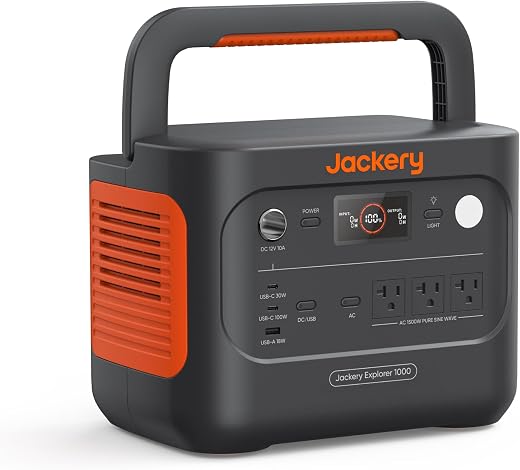



Jackery Explorer 1000 v2 Portable Power Station — 1070Wh LiFePO4, 1500W, 7 Outlets
Portable power stations spent their first decade as camping accessories and their second becoming household infrastructure. Grid outages have grown longer and more frequent across much of the United States, and a box that keeps a refrigerator, a router and a CPAP machine running through one has stopped looking like an indulgence. The question is which box, and at what weight. It is the most sensible one-kilowatt-hour station for a household that wants real backup without a permanent installation, and the compromise is that it will not run a heat-producing appliance for long.
| Price history for Jackery Explorer 1000 v2 Portable Power Station,1070Wh,1500W | |
|---|---|
|
Latest updates:
|
|

$559.00
Description
Jackery Explorer 1000 v2 Review — A Thousand Watt-Hours That Weighs Less Than a Toddler
Portable power stations spent their first decade as camping accessories and their second becoming household infrastructure. Grid outages have grown longer and more frequent across much of the United States, and a box that keeps a refrigerator, a router and a CPAP machine running through one has stopped looking like an indulgence. The question is which box, and at what weight.
The Explorer 1000 v2 is Jackery answering that with lithium iron phosphate chemistry, 1,070 watt-hours and a 23.8 pound carrying weight that a single person can genuinely move. It holds 4.7 stars across more than 3,500 ratings. We looked at what it will actually run, how long it lasts, and the several places where its own Amazon specification sheet is plainly wrong.
Quick verdict: the Jackery Explorer 1000 v2 scores 8.6/10 in this SoftPickr review. It is the most sensible one-kilowatt-hour station for a household that wants real backup without a permanent installation, and the compromise is that it will not run a heat-producing appliance for long.
Table of Contents
- Key Specifications
- Why LiFePO4 Is the Reason to Buy This Generation
- What 1,070 Watt-Hours Actually Runs
- Charging: Wall, Solar and the Realistic Numbers
- Reading the Specification Sheet Sceptically
- Limitations and Compromises
- Storage, Charge Cycles and Long-Term Care
- Who Should Buy It?
- SoftPickr Verdict
- Frequently Asked Questions
- Related Reviews

Key Specifications
| Feature | Specification |
|---|---|
| Model | JE-1000D (Explorer 1000 v2) |
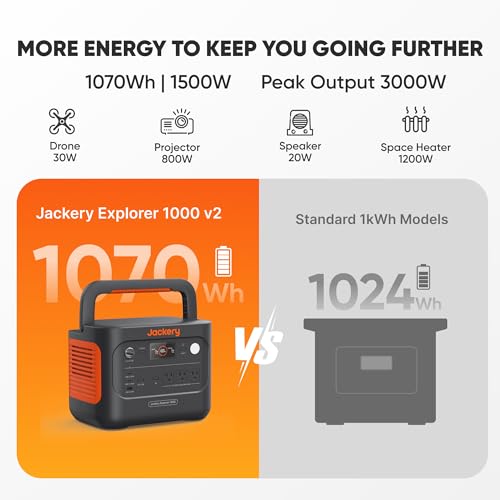
| Capacity | 1,070 Wh |
| Battery chemistry | LiFePO4 (lithium iron phosphate) |
| Continuous AC output | 1,500 W |
| Surge output | 3,000 W |
| Total outlets | 7 — AC, USB-C, USB-A and DC |
| AC specification | 120 V, 60 Hz, 12.5 A |
| Charging inputs | AC wall, solar and car |
| Runtime at full load | Approximately 42 minutes at a continuous 1,500 W draw |
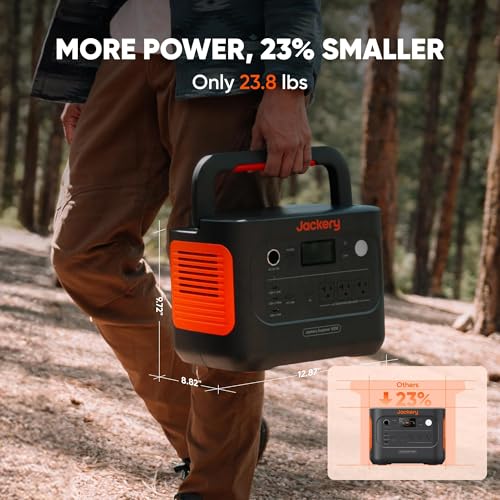
| Weight | 23.8 lb |
| Dimensions | 12.87 x 8.82 x 9.72 in |
| Recommended uses | Home backup, camping, emergencies |
Why LiFePO4 Is the Reason to Buy This Generation
The v2 designation matters more than a version number usually does, because it marks the move to lithium iron phosphate cells. The older nickel-manganese-cobalt chemistry used across the category delivers around five hundred full charge cycles before capacity falls off meaningfully. LiFePO4 delivers several thousand, which changes a power station from a consumable into equipment.
The second benefit is thermal behaviour. LiFePO4 is markedly more tolerant of heat and far less prone to thermal runaway, which is not an academic distinction for a large battery that will sit in a garage, a car boot or a cupboard for months at a time. It is heavier per watt-hour than the older chemistry, and Jackery has absorbed that penalty while still landing at 23.8 pounds.
What 1,070 Watt-Hours Actually Runs
The useful arithmetic is watts multiplied by hours. A modern refrigerator averaging 150 watts runs for roughly six hours on a full charge, allowing for inverter losses. A Wi-Fi router and modem at 20 watts run for two days. A CPAP machine without its humidifier lasts two full nights. A laptop charges from flat around fifteen times. Phone charges run into the dozens.
What it does not do is heat. A 1,500 watt space heater, a kettle, a hair dryer, a toaster or a microwave will all start — the 3,000 watt surge headroom sees to that — and will all drain the battery in well under an hour. The listing itself quotes a 42-minute runtime, which is the honest arithmetic of 1,070 watt-hours divided by a continuous 1,500 watt load, not a defect.
Charging: Wall, Solar and the Realistic Numbers
Wall charging is the fastest route and the one most owners use, bringing the unit from empty to full in a small number of hours with the supplied cable and no separate brick. For an emergency-preparedness buyer that is the number that matters, because a station charged the evening before a storm is worth more than one charging slowly through it.
Solar is the reason many people buy the category, and it is also where expectations need managing. Panel output falls with cloud, angle and season, and a 200 watt panel rarely delivers 200 watts in practice. A realistic figure for a full solar recharge of a 1,070 watt-hour battery is a full day of good sun with adequate panel area, which makes solar a sustainment strategy for a long outage rather than a fast top-up.
Reading the Specification Sheet Sceptically
This listing carries several fields that are plainly inherited from a gas generator template rather than describing the product. Engine Type is given as 4 Stroke, Fuel Type as Electricity, and the item type field literally reads TEST. The warranty field contains the single character 1. None of this reflects the hardware, which has no engine and burns no fuel.
We flag it because a specification table containing four obvious errors is not a table to buy from without checking the manufacturer page. The figures that do appear correct and internally consistent are capacity, output, surge, weight, dimensions and outlet count, and those are the ones this review relies on. Warranty terms in particular should be confirmed with Jackery directly rather than read off Amazon.
Limitations and Compromises
A thousand watt-hours is a real ceiling, and heat-producing appliances expose it immediately. Anyone whose backup plan involves a space heater, an electric kettle or a microwave for more than a few minutes needs a larger station, a second unit, or a different plan. This is the honest limit of the size class rather than a fault of this particular model, but it is the limit buyers most often discover after purchase.
The Amazon specification sheet is unusually unreliable for a product at this price. Engine type, fuel type, item type and warranty are all wrong or meaningless, which makes it impossible to confirm the warranty period from the listing. That is a genuine problem for a purchase of several hundred dollars, and it should be resolved with the manufacturer before ordering rather than after.
Solar charging requires panels that are not in the box, and the total outlay to reach a genuinely off-grid setup is meaningfully higher than the station price alone. At 23.8 pounds the unit is portable in the sense that one adult can carry it a short distance, not in the sense that it will be enjoyable to carry to a remote campsite.
Storage, Charge Cycles and Long-Term Care
A power station bought for emergencies spends most of its life doing nothing, and that is where owners lose capacity. Store it somewhere between roughly twenty and eighty percent charged rather than full or empty, in a cool, dry place, and top it up every three months. LiFePO4 is far more forgiving than older chemistry about this, but it is not indifferent to it.
Keep the vents clear and never run the unit inside a closed bag or a tight cabinet, because the inverter generates real heat at high loads. Wipe the ports occasionally, particularly if it lives in a garage where dust settles. Charge it fully before any planned use — a storm forecast, a camping trip, a scheduled outage — and treat the three-month reminder as the only routine maintenance the product needs.
Who Should Buy It?
- You want genuine household backup for a refrigerator, router, lights and medical equipment.
- Your area loses grid power more than once a year and outages last hours rather than minutes.
- You camp, work outdoors, or run equipment where no outlet exists.
- You want LiFePO4 cycle life rather than a battery that fades after a few hundred charges.
- You need something one adult can carry, not a wheeled unit or a fixed installation.
Look elsewhere if your backup plan involves heating anything — a space heater, kettle or microwave will drain a thousand watt-hours in under an hour and no amount of surge headroom changes that arithmetic. Look elsewhere too if you want whole-home backup including air conditioning, where a permanently installed system is the right answer, and if weight is the deciding factor for backpacking, since 23.8 pounds is a car-camping figure rather than a hiking one.
SoftPickr Verdict
The Jackery Explorer 1000 v2 earns 8.6/10. It is the right size for the job most people actually have. LiFePO4 cells that will still hold charge in a decade, 1,500 watts continuous with 3,000 watts of surge, seven outputs and a weight one person can carry make it a genuinely useful piece of household equipment rather than a gadget. At 4.7 stars it is also the best-rated station we surfaced in its class, and it takes our Editor Choice badge.
The compromise is heat. A thousand watt-hours will not carry a heater, a kettle or a microwave through an evening, and the listing quotes forty-two minutes at full load for exactly that reason. Buy it to keep a refrigerator, a router and the lights alive for a day, and it is excellent. Buy it to replace the grid and it will disappoint before the first hour is out.
Price and availability change frequently on Amazon, and prices shown here may be out of date — check the current listing before ordering.
Jackery Explorer 1000 v2 — Frequently Asked Questions
How long will the Jackery Explorer 1000 v2 run a refrigerator?
A typical modern refrigerator averages around 150 watts once duty cycling is accounted for, which works out to roughly six hours from 1,070 watt-hours after inverter losses. Older or larger units draw more. Opening the door less often extends that considerably, because the compressor runs far less when the cold air stays inside.
Can it be charged from solar panels, and how long does that take?
Yes, solar is one of three charging inputs alongside wall and car. Panels are sold separately. A realistic full recharge from solar needs a full day of good sun with adequate panel area, because real panel output falls well below the rated figure with cloud, angle and season. Treat solar as sustainment during a long outage rather than as fast charging.
Why does the listing say the engine type is 4 stroke?
Because the specification fields have been filled in from a gas generator template and are simply wrong. There is no engine and no fuel. Several other fields on the same listing are also incorrect, including one that reads TEST. Capacity, output, surge, weight and outlet count appear accurate; warranty terms should be confirmed with Jackery directly.
Is LiFePO4 worth paying for over the older battery chemistry?
For a product that will sit unused for months and be relied on in an emergency, yes. LiFePO4 delivers several thousand charge cycles against roughly five hundred for older nickel-manganese-cobalt cells, and it tolerates heat far better. It is heavier per watt-hour, which is the trade Jackery has absorbed to reach 23.8 pounds.
Ready to buy? You can check the current price of the Jackery Explorer 1000 v2 on Amazon — the listing shows live pricing and current stock, both of which move around more than the specification does. SoftPickr earns a commission on qualifying purchases at no extra cost to you.
Related Reviews
If the Jackery Explorer 1000 v2 is not quite the right fit, these SoftPickr reviews cover the closest alternatives we have tested:
Additional information
Specification: Jackery Explorer 1000 v2 Portable Power Station — 1070Wh LiFePO4, 1500W, 7 Outlets
|
Price History
| Price history for Jackery Explorer 1000 v2 Portable Power Station,1070Wh,1500W | |
|---|---|
|
Latest updates:
|
|


There are no reviews yet.