
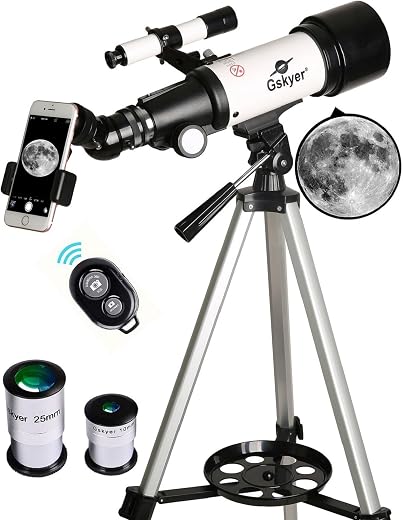




Gskyer AZ 70400 Telescope — 70mm Aperture, 400mm Refractor, Phone Adapter
Telescope buying goes wrong in a specific and predictable way. Someone spends around a hundred dollars, points the thing at the sky, sees a smeared white dot where they expected the Hubble photograph on the box, and the telescope spends the next decade in a cupboard. Almost none of that is the buyer fault, and most of it is the marketing. It shows you the Moon, Saturn rings and Jupiter moons properly, and the tripod is the part holding it back.
Original price was: $129.99.$96.99Current price is: $96.99.
 Amazon.com
| Price history for Gskyer Telescope, 70mm Aperture 400mm AZ Mount Astronomical Refracting Telescope for Kids Beginners - Travel Telescope with Carry Bag, Phone Adapter and Wireless Remote. | |
|---|---|
|
Latest updates:
|
|

Original price was: $129.99.$96.99Current price is: $96.99.
Description
Gskyer Telescope Review: An Honest Look At The Beginner Refractor Everyone Buys
Telescope buying goes wrong in a specific and predictable way. Someone spends around a hundred dollars, points the thing at the sky, sees a smeared white dot where they expected the Hubble photograph on the box, and the telescope spends the next decade in a cupboard. Almost none of that is the buyer fault, and most of it is the marketing.
The Gskyer AZ 70400 is the telescope that population overwhelmingly buys, with 4.3 stars across 22,044 Amazon ratings. It is a genuinely reasonable instrument for the money. What follows is an attempt to say exactly what it will and will not show you, because that expectation gap is the whole game here.
Quick verdict: the Gskyer telescope scores 8.0/10 in this SoftPickr review. it shows you the Moon, Saturn rings and Jupiter moons properly, and the tripod is the part holding it back.
Table of Contents
Key Specifications
| Feature | Specification |
|---|---|
| Model | Gskyer AZ 70400 |
| Optical design | Refractor, fully coated glass |
| Aperture | 70 mm (7 cm objective) |
| Focal length | 400 mm |
| Focal ratio | f/5.7 |
| Mount | Altazimuth on an adjustable aluminium tripod |
| Finder | Reflex red-dot finder |
| Eyepieces | Two supplied plus a Barlow lens |
| Focus | Manual rack and pinion |
| Extras | Smartphone adapter and wireless camera remote |
| Optical tube length | 40 cm |
| Weight | 5.7 lb, with carry bag and 1 year warranty |
What You Will Actually See
The Moon is spectacular through this, and that is not faint praise. At 70mm of aperture and 400mm focal length you get craters along the terminator with real depth, mountain ranges, and the ray systems around Tycho and Copernicus. Anyone who has only seen the Moon with their eyes will find the first night genuinely startling, and it is the single most reliable target this telescope has.
Saturn shows its rings as a distinct separated shape rather than a blur, and Jupiter shows as a small disc with two cloud belts and the four Galilean moons strung out beside it. Venus shows phases. What you will not see is colour and detail in nebulae or spiral structure in galaxies; those need far more aperture, and no eyepiece swap changes that.
Optics, Eyepieces and the Barlow
The fully coated 70mm objective is decent for the price and the f/5.7 focal ratio gives a comparatively wide field, which makes finding things much easier than a long slow telescope would. Chromatic aberration, the purple fringing on bright objects that all cheap refractors show, is present on the Moon limb and on Venus, and it is normal rather than a fault.
Two eyepieces and a Barlow lens ship in the box, and the Barlow doubles or triples whatever eyepiece it is paired with. Used at the low end this gives genuinely useful magnifications. Used to chase the highest number on the box it produces a dim, mushy, unusable image, which is exactly how most beginners conclude their telescope is broken when it is not.
The Phone Adapter and Red-Dot Finder
The included smartphone adapter clamps a phone over the eyepiece, and paired with the supplied wireless shutter remote it produces genuinely shareable photographs of the Moon without touching the telescope. That last part matters: at these magnifications, pressing a shutter button by hand shakes the image for several seconds. The remote is a small accessory that changes the result completely.
The reflex red-dot finder is a better choice for beginners than a magnifying finderscope, because it shows the sky at true scale with a floating dot rather than an inverted magnified view that is hard to relate to what your eyes see. Align it in daylight against a distant fixed object before your first night out, or you will spend that night hunting.
Portability and Setup
The whole instrument weighs 5.7 pounds and the optical tube is 40 centimetres long, so it packs into the supplied carry bag and travels in a car boot without ceremony. That portability is a real astronomical advantage, because the difference between a dark rural sky and a suburban garden is far larger than the difference between 70mm and 90mm of aperture.
Setup runs to a few minutes: extend the tripod legs, seat the tube in the mount, fit the diagonal and an eyepiece, and align the red dot. There is no polar alignment and no electronics, which is the correct decision for a first telescope. Everything about using it is manual, immediate and understandable, and that is a genuine virtue.
Limitations and Compromises
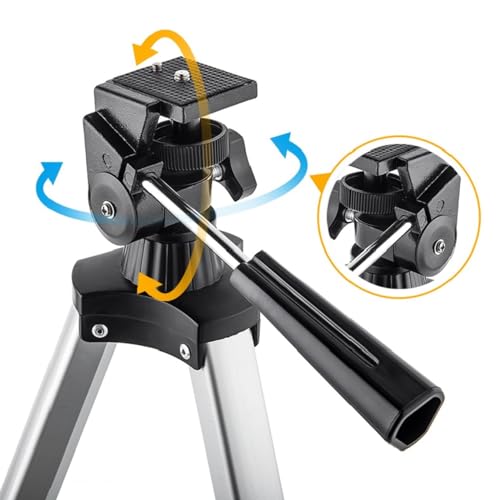
The tripod is the weak point and it is the reason this scores where it does. The aluminium legs are light, and at higher magnifications a nudge, a breeze or the act of focusing sets the image wobbling for several seconds. Nothing degrades the observing experience more. Hanging a weight from the tripod centre helps, and the honest fix is a sturdier mount that costs more than the telescope.
Marketing for telescopes in this class quotes magnification figures that the optics cannot support. A 70mm aperture has a maximum useful magnification of roughly 140 times, and this listing carries a Zoom Ratio field of 120. Beyond that limit you are enlarging a blur. Treat any three-figure magnification claim on any small telescope as a number rather than a capability.
Several fields in the Amazon listing do not describe this instrument. Power Source reads Adapter on a telescope that has no electronics at all, and the 5.8 degree field of view figure belongs to the red-dot finder rather than the main optical tube, which at 400mm focal length delivers roughly three degrees at its widest eyepiece. Read the physical specifications and disregard the rest.
Care and Collimation
Refractors need almost no maintenance, which is the second reason they suit beginners: there is no mirror to collimate and the optics are sealed inside the tube. Leave the dust caps on when it is not in use, and resist cleaning the objective lens; a coated lens survives a surprising amount of dust with no visible effect, and every cleaning risks a scratch that is permanent.
Let the telescope cool outdoors for fifteen to twenty minutes before observing, because warm air inside the tube distorts the image until it equalises. Store eyepieces capped in a box rather than loose in the bag, and keep the whole instrument somewhere dry; condensation on the objective at the end of a cold night should be allowed to evaporate indoors, not wiped off.
Who Should Buy It?
- Absolute beginners who want to see the Moon, Saturn and Jupiter properly for the first time
- Parents buying for a child old enough to handle a manual instrument with supervision
- Anyone who wants a telescope light enough to actually carry to a dark sky site
- People who want to photograph the Moon through a phone without extra accessories
- Buyers who would rather learn the sky manually than depend on a motorised go-to mount
Look elsewhere if you want to see nebulae and galaxies with any structure, because that requires far more aperture than 70 millimetres however good the eyepieces are. Skip it too if a wobbling image at higher magnification will frustrate you into abandoning the hobby, in which case a heavier mount matters more than the optics, or if you would rather a computer found the targets for you.
SoftPickr Verdict
The Gskyer telescope earns 8.0/10. It does the job a first telescope exists to do: it makes the Moon extraordinary, resolves Saturn rings and Jupiter moons, weighs little enough to take somewhere genuinely dark, and includes the phone adapter and remote that turn a first night into photographs worth keeping. Over 22,000 ratings at 4.3 stars reflect a lot of people getting a real introduction to the sky.
The one compromise is the tripod, and it is why there is no badge here. A light aluminium mount that shivers for several seconds after every focus adjustment is the single biggest obstacle between a beginner and a good view. The optics deserve better support than they get, and anyone who enjoys their first year with this should put the upgrade money into a mount rather than a bigger tube.
Price and availability change frequently on Amazon, and prices shown here may be out of date — check the current listing before ordering.
Gskyer telescope — Frequently Asked Questions
Can I see Saturn rings with the Gskyer telescope?
Yes. At 70mm aperture and reasonable magnification the rings are clearly separated from the planet disc rather than appearing as a bulge, which is the view that convinces most beginners the hobby is worth pursuing. You will not see the Cassini division or ring shading, which need substantially more aperture and steady atmospheric conditions.
Is this telescope good for viewing galaxies and nebulae?
Only in a very limited sense. Bright targets like the Orion Nebula and the Andromeda galaxy are visible as faint grey smudges from a dark site, with no colour and no structure. Deep sky observing is an aperture problem, and 70 millimetres is not enough. Photographs of colourful nebulae are long exposures, not what any eye sees through any telescope.
Do I need extra eyepieces?
Not to begin with. The two supplied eyepieces plus the Barlow lens give you a sensible range of magnifications for the Moon and planets. A better use of early money is a steadier tripod or mount, since image shake limits this instrument more than eyepiece quality does. Add a wide-field eyepiece later if you find yourself observing regularly.
Is it suitable for a child?
Yes, with supervision. It is manual, light at 5.7 pounds and has nothing electronic to break, and the red-dot finder is far easier for a child to understand than a magnifying finderscope. The realistic caveat is expectations: a child shown a picture of Jupiter from a spacecraft will be disappointed, and a child shown the Moon will not be.
Ready to buy? You can check the current price of the Gskyer telescope on Amazon — the listing shows live pricing and current stock, both of which move around more than the specification does. SoftPickr earns a commission on qualifying purchases at no extra cost to you.
Related Reviews
If the Gskyer telescope is not quite the right fit, these SoftPickr reviews cover the closest alternatives we have tested:
Additional information
Specification: Gskyer AZ 70400 Telescope — 70mm Aperture, 400mm Refractor, Phone Adapter
|
Price History
| Price history for Gskyer Telescope, 70mm Aperture 400mm AZ Mount Astronomical Refracting Telescope for Kids Beginners - Travel Telescope with Carry Bag, Phone Adapter and Wireless Remote. | |
|---|---|
|
Latest updates:
|
|

There are no reviews yet.