Hinomi H2 Pro vs HBADA E3 — Two Mesh Chairs, Two Different Bets
These two chairs keep landing in the same shortlist, and it is easy to see why. Both are full-mesh task chairs. Both put a real adjustable headrest on top, flip-up arms on the sides, and a lumbar system they are prepared to argue about. Both are sold to the same person: someone who has decided a $40 office chair is a false economy and now wants to know what the next step up actually buys.
The chairs answer that question in opposite directions. The Hinomi H2 Pro spends its money on movement — lumbar that tracks your spine, armrests with five axes, a leg rest that slides out of the seat. The HBADA E3 Air spends its money on fit, and does it at a price that is not close. Picking between them is less about which chair is better and more about which of those two things you are actually short of.
Quick verdict: the Hinomi H2 Pro is the better chair and we scored it 9.1 against the E3 Air’s 8.8 — but it costs enough more that the E3 Air is the right buy for most people, and for anyone under about 5’8″ it is arguably the better fit regardless of price.
First, a note on the E3 naming
HBADA sells the E3 as a line rather than a single chair, and searches for “E3 Pro” and “E3 Air” both turn up. The chair we have reviewed and the chair compared here is the E3 Air. If you are looking at a listing labelled E3 Pro, check its lumbar and armrest specs against the table below before assuming this comparison transfers — the shared model name does not guarantee shared hardware, and we do not publish specs we have not verified.
Specification comparison
| Spec | Hinomi H2 Pro | HBADA E3 Air |
|---|---|---|
| Lumbar support | 3D dynamic — moves up/down, in/out, and rotates with the spine | 3-zone elastic, 8-way adjustment |
| Headrest | 3D — height, tilt and depth | 3D adjustable |
| Armrests | 5D flip-up (height, width, depth, angle, pivot) | 4D adjustable |
| Leg rest | Retractable, built into the seat | None — footrest sold separately |
| Recline | Up to 136°, 4-position lock | Up to 140°, gravity-sensing chassis |
| Seat depth | Adjustable slider | Adjustable, plus backrest height |
| Backrest mesh | Dual-layer, independent upper/lower tension | CloudMesh, single layer |
| Weight capacity | 275 lb | 300 lb |
| Best height range | 5’0″ to 6’4″ | 5’1″ to 5’8″ |
| Warranty | 5 years frame, 2 years parts | Not published on the listing |
| Certifications | BIFMA, SGS | Not published on the listing |
| Price | From $649 | Consistently the cheaper chair |
| SoftPickr score | 9.1 | 8.8 |
The lumbar systems are genuinely different, not just differently marketed
This is the one specification worth reading slowly, because it is where the money goes.
The E3 Air uses a 3-zone elastic lumbar with 8-way adjustment. You set it once — height, depth, tension across three bands — and it holds that shape. It is a good static fit, and “static” is not an insult: most back pain from a chair comes from a support that sits in the wrong place, and a system with eight ways to move it will find the right place.
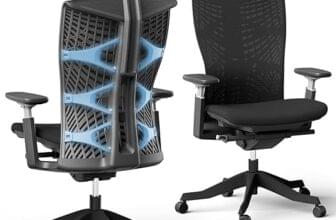
The H2 Pro’s 3D dynamic lumbar does something else. It moves up and down, in and out, and rotates, and it keeps doing that while you sit. When you twist to reach a drawer, the support follows rather than becoming a fixed lump you are now twisting against. Whether that matters depends almost entirely on how long you sit. For a four-hour day, a well-set static lumbar is fine. Past about six hours, the chair that keeps moving with you is the one you stop noticing, and not noticing your chair is the entire point.
Fit is where the cheaper chair wins outright
The H2 Pro covers 5’0″ to 6’4″, which is an unusually wide range and the reason it survives being a household’s only good chair. The E3 Air is happiest between 5’1″ and 5’8″ and starts feeling small above roughly 6’2″.
Read that as a strength rather than a limitation. A chair engineered around a narrower band of bodies fits that band better than a chair engineered to fit everyone. If you are inside the E3 Air’s range, you are buying a chair built for your proportions, and the CloudMesh — noticeably more elastic than standard mesh — flexes properly under lighter body weights instead of feeling like a taut trampoline. Stiff mesh is a real complaint from lighter users and this is the direct answer to it.
If you are over 6’2″, or buying one chair that several people of different heights will use, the H2 Pro is the only one of the two that makes sense. If you are tall, our best office chair for tall people guide is the better starting point than either chair here.
The specification that reverses the price order
The H2 Pro is rated to 275 lb. The E3 Air is rated to 300 lb. The more expensive chair carries less.
That is not a defect — 275 lb covers most users comfortably, and Hinomi publishes BIFMA and SGS certification behind the figure, which is more than the E3 Air’s listing does. But it is worth saying plainly, because “premium” is usually assumed to include “sturdier”, and here it does not. If you are near either number, buy the chair with the higher rating and the published test standard, and be aware that only one of these two publishes a standard at all.
Armrests, headrest and the leg rest
Both chairs give you a 3D headrest, and both are worth having — a headrest that only tilts is decoration.
The armrests separate them. The E3 Air’s 4D arms move in the four directions that matter. The H2 Pro adds a fifth axis, pivot, and both flip up out of the way. The fifth axis is a smaller upgrade than the spec-sheet gap suggests; the flip-up is the feature you will use daily if your desk has a keyboard tray or you pull the chair fully under it.
The retractable leg rest is the H2 Pro’s one genuinely unusual feature, and it is the most polarising thing about the chair. It slides out of the seat, and for people who read or take calls from their desk chair it converts the chair into something else entirely. For people who only ever work at the chair, it is weight and cost you will never deploy. Be honest with yourself about which you are — it is a meaningful slice of the price difference.
Recline and mesh
The E3 Air reclines slightly further, to 140° against the H2 Pro’s 136°, and uses a gravity-sensing chassis that adjusts resistance to your body weight instead of asking you to dial in tension. That is a nicer default for someone who will never touch the settings again.
The H2 Pro locks at four positions and uses a dual-layer backrest with independent upper and lower tension, so shoulder and lumbar firmness are set separately. If you have ever wanted the lower back firm and the upper back soft, that is the feature that does it, and the E3 Air’s single mesh layer cannot.
What neither listing tells you
Both chairs omit something a buyer should have.
The E3 Air publishes no warranty term and no certification on its listing. On a chair in this price bracket that is the wrong thing to leave out — a gas lift and a chassis are the parts that fail, and the warranty is the only statement about how confident the maker is in them. The H2 Pro’s 5-year frame and 2-year parts coverage is not extraordinary, but it exists and it is written down.
The H2 Pro’s price is quoted “from”, and the configuration people actually want is rarely the base one. Budget above the headline number rather than at it.
Prices on both move a great deal, and the E3 Air’s has swung widely over the past year. We do not publish a live figure here because it would be wrong within a week — check the current price on each review before you decide the gap is what you think it is.
Which one should you buy
- Buy the HBADA E3 Air if you are between roughly 5’1″ and 5’8″, if you sit four to six hours rather than eight, if lighter body weight has made stiff mesh uncomfortable before, or if the price difference is the deciding factor — which for most people it honestly is.
- Buy the Hinomi H2 Pro if you sit eight hours or more, if you are above 5’8″ or buying for several people, if you want the lumbar to keep working while you move rather than holding one shape, or if the leg rest is something you will genuinely use.
- Buy neither if you are over 6’4″, if you want a cushioned seat rather than mesh — neither chair offers one — or if your budget is under about $250, where you are better served by a simpler chair that does three things properly than by a cheap imitation of these.
SoftPickr verdict
The Hinomi H2 Pro wins on paper and in our scoring, 9.1 to 8.8, and if the two chairs cost the same it would not be a close contest. They do not cost the same. The E3 Air gives up dynamic lumbar, the fifth armrest axis, the leg rest and the dual-layer backrest — and keeps the 3D headrest, adjustable seat depth, a further recline, a higher weight rating and a mesh that suits lighter users better.
That is a lot of chair to keep. The H2 Pro is the better chair; the E3 Air is the better buy for most people, and the clean dividing line is how many hours you sit in it. Six or more, spend the money. Fewer than that, the cheaper chair will not be the reason your back hurts.
Is the Hinomi H2 Pro worth twice the price of the HBADA E3 Air?
For eight-hour days, yes — the dynamic lumbar and the dual-layer backrest are things you feel by hour six. For shorter days, no. The E3 Air’s 8-way lumbar, set correctly once, covers most of the benefit.
Which chair is better for short users?
The HBADA E3 Air. It is engineered around the 5’1″ to 5’8″ range, and its more elastic mesh flexes properly under lighter body weight where stiffer mesh stays taut.
Does the HBADA E3 Air hold more weight than the Hinomi H2 Pro?
Yes — 300 lb against 275 lb. The cheaper chair has the higher rating. The H2 Pro, though, publishes BIFMA and SGS certification behind its figure and the E3 Air’s listing publishes none.
Is the HBADA E3 Pro the same chair as the E3 Air?
Not necessarily. HBADA sells the E3 as a line and the variants differ. Our review covers the E3 Air; if a listing says E3 Pro, check its lumbar, armrest and capacity specs against the table above before assuming this comparison applies.
Related reviews
- Hinomi H2 Pro review — the full breakdown of the dynamic lumbar, leg rest and 5D armrests.
- HBADA E3 Air review — why the T-Shape support system works so well for smaller frames.
- Best ergonomic office chairs for small frames — where both chairs sit against the rest of the field.