


Franklin Sensors ProSensor M210 13-Sensor Stud Finder — Live Wire Detection, 1.7 in Depth
Almost everyone who has hung a shelf has had the experience of a stud finder beeping in three different places on the same wall and then being wrong about all of them. Single-sensor stud finders work by comparing readings as you slide them, which means they need calibrating against a hollow section first and will confidently report nonsense if they do not get one. Thirteen sensors mean no calibration and no guessing, and it will not see through thick plaster.


| Price history for Franklin Sensors ProSensor M210 13-Sensor Stud Finder, Live Wire Detection | |
|---|---|
|
Latest updates:
|
|

$59.97
Description
Franklin Sensors ProSensor M210 Review — The Stud Finder That Does Not Lie to You
Almost everyone who has hung a shelf has had the experience of a stud finder beeping in three different places on the same wall and then being wrong about all of them. Single-sensor stud finders work by comparing readings as you slide them, which means they need calibrating against a hollow section first and will confidently report nonsense if they do not get one.
The ProSensor M210 does something structurally different, and it is the reason we have given a $59.97 tool with only 6,280 ratings the round Editor Choice. This is the thinnest evidence base in this round by a wide margin, and it holds 4.6 stars, so we spent the review examining whether the design justifies the confidence.
Quick verdict: the Franklin Sensors ProSensor M210 scores 8.6/10 in this SoftPickr review. Thirteen sensors mean no calibration and no guessing, and it will not see through thick plaster.
Table of Contents
- Key Specifications
- Thirteen Sensors Instead of One
- You See the Width, Not Just an Edge
- Live Wire Detection and Why It Is Separate
- A Thin but Very Consistent Rating Base
- Limitations and Compromises
- Using It Well and Keeping It Accurate
- Who Should Buy It?
- SoftPickr Verdict
- Frequently Asked Questions
- Related Reviews

Key Specifications
| Feature | Specification |
|---|---|
| Model | ProSensor M210 (FSM21012HD) |
| Sensor array | 13 independent sensors |
| Display | LED array showing stud position and width |
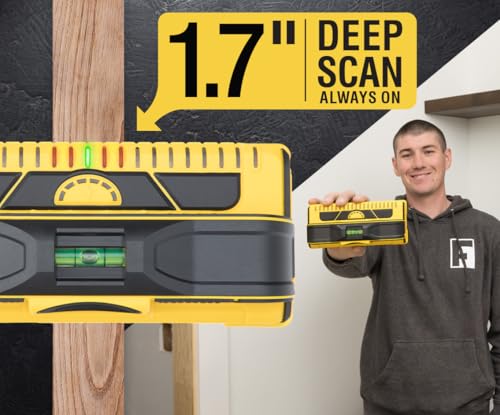
| Sensing depth | 1.7 in |
| Live wire detection | Yes |
| Calibration required | None |
| Supply voltage | 3 volts |
| Current draw | 150 mA |
| Operating temperature | 32 to 110 degrees F |
| Body material | Plastic |
| Dimensions | 7.5 x 3.35 x 3.33 in |
| Weight | 273 g |
Thirteen Sensors Instead of One
A conventional stud finder has a single sensor and infers a stud from how the reading changes as you drag it across the wall. That requires a reference measurement over a hollow section, which is why these tools ask you to hold a button and wait, and why they fail so badly when you happen to start over a stud.
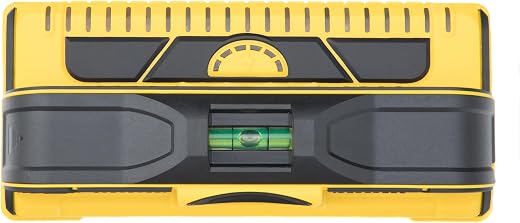
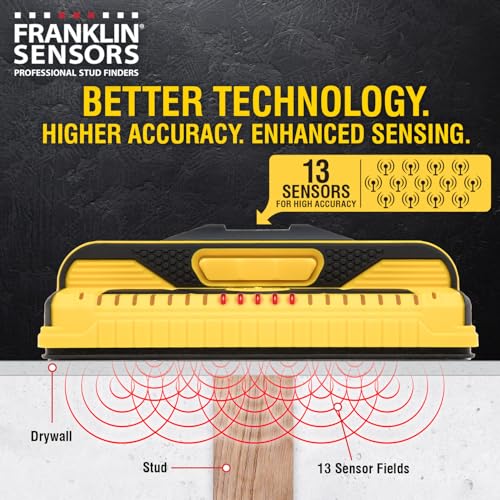
The M210 has thirteen sensors in a row, each reporting independently to its own LED. You press it flat against the wall and the LEDs above solid material light up immediately. There is no sliding, no calibration and no inference, which removes the single largest source of error in the whole category at a stroke.
You See the Width, Not Just an Edge
Because the whole array reports at once, the lit LEDs show you both edges of the stud and everything in between. That tells you the stud is a standard width rather than a pipe or a nail plate, and it tells you exactly where the centre is without the two-pass edge-finding routine that conventional stud finders require.
The practical difference shows up on ceilings and on walls with unusual framing. A single-sensor tool will find something and leave you to guess what it is. An array that lights up 40 mm of solid material is telling you a very different story from one that lights up a single sensor, and that distinction is the whole value of the tool.
Live Wire Detection and Why It Is Separate
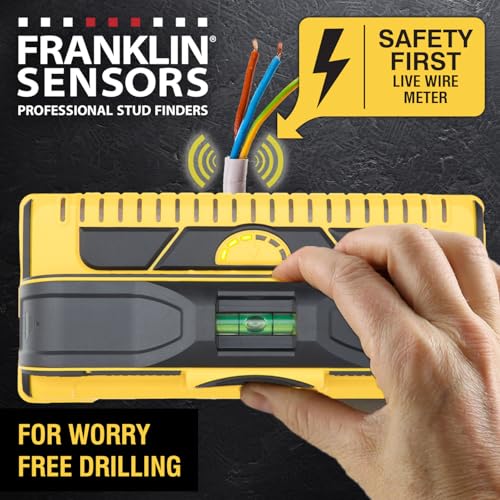
The M210 warns when it detects live AC wiring behind the surface, which is a different measurement from density sensing and is reported separately. That separation matters, because a tool that lumps electrical detection in with stud detection gives you a warning you cannot interpret and therefore learn to ignore.
It is worth being clear about the limits: no consumer detector guarantees it will find every cable, particularly a dead circuit or one behind metal. Treat the warning as a strong reason to stop and never as a certificate that the wall is safe. Combined with a 1.7 inch sensing depth, that is a sensible tool used sensibly.
A Thin but Very Consistent Rating Base
Six thousand two hundred and eighty ratings is the smallest evidence base in this round and it needs saying plainly. What makes it persuasive rather than merely small is the distribution: 4.6 stars with an unusually high proportion of reviews from trades rather than one-off DIY buyers, which is not the normal pattern for a wall scanner.
The recurring criticism is price. At $59.97 this costs three times what a basic electronic stud finder does, and for somebody hanging one picture a year that is difficult to justify. For anyone who has ever put four holes in a wall looking for one stud, the arithmetic looks entirely different.
Limitations and Compromises
Sensing depth is 1.7 inches, which covers standard single-layer drywall comfortably and runs out on thick plaster and lath, double-layered drywall or tiled walls. On an older house with a plaster over lath ceiling the tool may find nothing at all, and there is no deep-scan mode to switch to. Check what your walls are made of before assuming this will work.
At $59.97 it is roughly three times the price of a basic single-sensor stud finder, and about half of what the top of the Franklin Sensors range costs. Nothing about the build feels premium either; it is a plastic body with an LED strip and no case in the box. You are paying for the sensor array and nothing else, which is the honest way to look at it.
The evidence base is 6,280 ratings, the thinnest of the ten products in this round by a considerable margin, and the ProSensor line is a niche product from a small manufacturer rather than a category leader by volume. That is not a mark against the tool, but anyone who weights crowd evidence heavily should know it before buying.
Using It Well and Keeping It Accurate
Hold it flat with even pressure across the whole face rather than pressing one corner, because the sensors read through the housing and a tilted tool gives an uneven picture. Take a second reading a few inches above or below the first: two readings that agree tell you the stud is vertical framing rather than a horizontal noggin or a pipe.
Take the batteries out if it is going into a toolbox for a season, and keep the sensing face away from metal in storage, because scratches across the face are the one form of damage that affects readings. It has an operating range of 32 to 110 degrees Fahrenheit, so a reading taken in a freezing garage in winter is worth repeating indoors.
Who Should Buy It?
- You have been let down by a sliding single-sensor stud finder and want to stop guessing.
- You hang shelves, cabinets or televisions often enough that accuracy is worth real money.
- You want to see the full width of a stud rather than hunt for its edges.
- You have standard drywall rather than thick plaster and lath.
- You want live wire warning reported separately from density detection.
Look elsewhere if your walls are plaster over lath, double-layered or tiled, because 1.7 inches of sensing depth will not reach the framing and no setting on this tool changes that. Look elsewhere too if you hang one picture a year, where a twenty dollar detector used carefully will do. And if you need to locate rebar or pipes in a solid wall, this is the wrong class of instrument entirely.
SoftPickr Verdict
The Franklin Sensors ProSensor M210 earns 8.6/10. This is a rare case of a tool solving the actual problem in its category rather than adding features around the edge of it. Thirteen sensors reporting at once removes calibration, removes sliding and removes the guesswork that makes conventional stud finders untrustworthy, and it shows you stud width rather than a beep.
The one compromise is depth. At 1.7 inches it is a drywall tool, and on plaster and lath it will simply not reach. That, and a 6,280-rating evidence base that is thin next to everything else in this round, are the honest caveats on a tool that otherwise earns its Editor Choice comfortably.
Price and availability change frequently on Amazon, and prices shown here may be out of date — check the current listing before ordering.
Franklin Sensors ProSensor M210 — Frequently Asked Questions
How is the Franklin Sensors ProSensor M210 different from a normal stud finder?
A normal stud finder has one sensor and infers a stud from changes as you slide it, which requires calibration over a hollow section and fails if you start over a stud. The M210 has thirteen sensors reading simultaneously, so you press it flat and the LEDs above solid material light up. No calibration, no sliding, no inference.
Will it work on plaster and lath walls?
Often not. Sensing depth is 1.7 inches, which handles standard single-layer drywall easily but runs out on thick plaster over lath, double-layered drywall or tiled surfaces. There is no deep-scan mode. If you live in an older house with plaster walls, check the wall construction before relying on this tool.
Does the live wire detection make drilling safe?
It makes it safer, not safe. The M210 warns about live AC wiring behind the surface, but no consumer detector will reliably find a dead circuit or a cable behind metal. Treat a warning as a reason to stop and investigate, and never treat the absence of a warning as confirmation that the wall is clear.
Is it worth three times the price of a basic stud finder?
It depends how often you use one. For someone hanging a picture once a year, probably not. For anyone who mounts shelves, cabinets or televisions regularly, the time saved and the holes not drilled repay it quickly, which is why an unusually high share of its reviews come from trades rather than occasional users.
Ready to buy? You can check the current price of the Franklin Sensors ProSensor M210 on Amazon — the listing shows live pricing and current stock, both of which move around more than the specification does. SoftPickr earns a commission on qualifying purchases at no extra cost to you.
Related Reviews
If the Franklin Sensors ProSensor M210 is not quite the right fit, these SoftPickr reviews cover the closest alternatives we have reviewed:
Additional information
Specification: Franklin Sensors ProSensor M210 13-Sensor Stud Finder — Live Wire Detection, 1.7 in Depth
|
Price History
| Price history for Franklin Sensors ProSensor M210 13-Sensor Stud Finder, Live Wire Detection | |
|---|---|
|
Latest updates:
|
|
There are no reviews yet.