
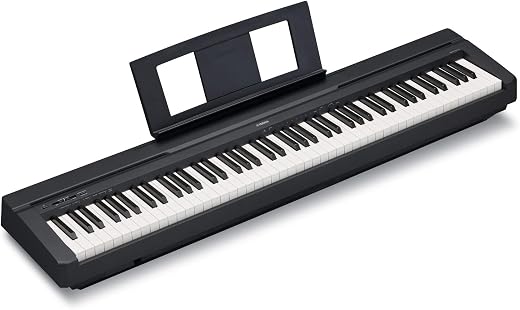


Yamaha P71 Digital Piano — 88 Weighted Keys, Sustain Pedal Included
Almost everyone who learns piano at home learns on the wrong instrument. Unweighted keyboards teach a technique that has to be unlearned the first time you sit at a real piano, because fingers trained on springs have never had to develop the strength that hammers demand. Teachers say this constantly and are routinely ignored, usually on price. The action is the whole product and it is excellent for the money, but this is an instrument with no recording, no app and no Bluetooth, and it does not pretend otherwise.
 Amazon.com
Description
Yamaha P71 Digital Piano Review: The Beginner Benchmark, Twelve Years On
Almost everyone who learns piano at home learns on the wrong instrument. Unweighted keyboards teach a technique that has to be unlearned the first time you sit at a real piano, because fingers trained on springs have never had to develop the strength that hammers demand. Teachers say this constantly and are routinely ignored, usually on price.
The Yamaha P71 is the answer to that objection. It is an Amazon-exclusive variant of the P45, the instrument that has been the default recommendation for beginners for over a decade, and it has 88 fully weighted keys. Everything else about it is deliberately unremarkable, which is either the point or the problem depending on what you want.
Quick verdict: the Yamaha P71 digital piano scores 8.7/10 in this SoftPickr review. The action is the whole product and it is excellent for the money, but this is an instrument with no recording, no app and no Bluetooth, and it does not pretend otherwise.
Table of Contents
- Key Specifications
- Graded Hammer Standard Action Is the Entire Argument
- Ten Voices, and Why That Is Enough
- Duo Mode and the Headphone Jack
- Portability and the Furniture Question
- Limitations and Compromises
- Key Care, Placement and Long-Term Storage
- Who Should Buy It?
- SoftPickr Verdict
- Frequently Asked Questions
- Related Reviews
Key Specifications
| Feature | Specification |
|---|---|
| Model | Yamaha P71 (Amazon-exclusive variant of the P45) |
| Keys | 88, fully weighted graded hammer standard action |
| Touch response | Four levels, adjustable |
| Included | Sustain pedal and power supply |
| Connectivity | USB to host, auxiliary |
| Headphones | 3.5 mm jack for silent practice |
| Speakers | Built in |
| Modes | Duo mode for teacher and student side by side |
| Dimensions | 52.25 in W x 11.5 in D x 6 in H |
| Weight | 25 lb |
| Colour | Black |
| Warranty | 1 year manufacturer warranty |
Graded Hammer Standard Action Is the Entire Argument
The P71 uses Yamaha’s GHS action, in which real hammers are graded across the keyboard: heavier in the bass, lighter in the treble, exactly as on an acoustic piano. This is not a simulation through springs and weights but a mechanical hammer under each key, and the difference is immediately obvious to anyone who has played both.
What it buys a learner is transferable technique. Finger strength, dynamic control and evenness developed on a weighted action work unchanged on an acoustic piano; the same skills developed on a springed keyboard do not, and have to be rebuilt. For anyone taking lessons, or expecting to sit exams, this single specification is worth more than every other feature combined.
Ten Voices, and Why That Is Enough
The P71 has ten sounds. A modern arranger keyboard at the same price has six hundred, and that comparison is used to sell a lot of the wrong instruments. What matters is that the primary voice, a sampled Yamaha grand, is genuinely good, and that the electric pianos, organs, harpsichord and strings around it are usable rather than novelty.
The design decision here is honest: Yamaha spent the money on the action and the main piano sample rather than on a sound list. If you want to play piano, ten good voices is ten more than you need. If you want to build backing tracks, program drums or explore synthesis, this is the wrong instrument and no amount of good action will change that.
Duo Mode and the Headphone Jack
Duo mode splits the keyboard into two identical 44-key ranges with the same pitch, so a teacher and student can sit side by side playing the same notes in the same octave. It is a small feature that reflects who the instrument was designed for, and anyone learning with a parent or teacher will use it constantly.
The 3.5 mm headphone jack matters more than it sounds. A beginner practising an hour a day is repetitive by definition, and the ability to make that silent to everyone else in the house is often what determines whether the practice actually happens. This is the single largest practical advantage a digital piano holds over an acoustic one in a flat or a shared home.
Portability and the Furniture Question
At 25 lb and 52.25 inches wide, this is a slab piano rather than a cabinet instrument. One person can move it, it fits in a car, and it takes a folding X-stand or a proper Z-stand. That flexibility is real: it can live on a stand in a bedroom and go to a lesson or a rehearsal in the same week.
It also means it does not look like furniture, and it does not include a stand or a bench. Budget roughly fifty dollars for a stand and forty for an adjustable bench, because playing at the wrong height teaches poor posture and wrist position. Yamaha sells the P-series in cabinet form under different model numbers if a permanent piece of furniture is what you want.
Limitations and Compromises
There is no Bluetooth, no app, no onboard recording and no MIDI over anything but a USB cable. In 2026 that is genuinely dated, and it is a real limitation for anyone who wants to record a practice session, follow along with a learning app, or connect wirelessly to a tablet. The USB-to-host port works perfectly with a computer and a cheap adapter for an iPad, but you will be buying cables to do what newer instruments do out of the box.
The specification sheet contains two claims worth ignoring. It records “Supported Software: Logic Pro”, which implies a compatibility restriction that does not exist — the P71 is a class-compliant USB MIDI device and works with any DAW or notation software on any platform. It also lists “Operating System: Built-In Software”, which is not meaningful information about anything. Both are field-filling rather than specification.
The included sustain pedal is a small plastic footswitch rather than a piano-style damper pedal, and it does not support half-pedalling. For a beginner in the first two years this is fine. For anyone playing romantic repertoire where pedal shading matters, a proper continuous damper pedal is a thirty-dollar upgrade that the instrument fully supports and that most owners eventually make.
Key Care, Placement and Long-Term Storage
Keep it out of direct sunlight and away from radiators. Digital pianos are far more tolerant of humidity than acoustic ones, which is one of their genuine advantages, but heat cycling still degrades adhesives and plastics over years. Wipe the keys with a barely damp cloth and dry them immediately; household cleaners will haze the key surfaces and there is no way to restore them.
Cover it when not in use, because dust falling between the keys is the main cause of unresponsive or noisy keys in older P-series instruments. If a key does start to feel gritty, do not attempt to remove key tops — the GHS action is serviceable but not by hand. Coil the power supply loosely rather than tightly around itself, since the strain relief at the plug is the most common point of failure.
Who Should Buy It?
- You or your child are taking piano lessons properly.
- You want technique that transfers to an acoustic piano.
- You need to practise silently through headphones in a shared home.
- You want the instrument to be movable rather than furniture.
- You value one excellent piano sound over six hundred mediocre ones.
Look elsewhere if you want to record, use learning apps wirelessly, or connect over Bluetooth, where newer Yamaha P-series models and Roland alternatives include all three. Look elsewhere too if you want an arranger with rhythms and hundreds of voices for songwriting, and if the piano will live permanently in one room as furniture, a cabinet-style console model looks and sounds better for a modest premium.
SoftPickr Verdict
The Yamaha P71 digital piano earns 8.7/10. A decade after it appeared, this is still the instrument to recommend to a beginner, and the reason has not changed: the graded hammer action teaches technique that transfers, and almost nothing else near this price does. Ten good voices, a proper headphone jack and duo mode cover what a learner actually needs, and Yamaha’s piano sample remains excellent.
The compromise is connectivity, and it is a real one in 2026. No Bluetooth, no recording, no app support, and a footswitch pedal rather than a damper. If any of those matter to you, spend more on a current P-series model. If what you want is to learn to play the piano, this is still the answer.
Price and availability change frequently on Amazon, and prices shown here may be out of date — check the current listing before ordering.
Yamaha P71 digital piano — Frequently Asked Questions
What is the difference between the Yamaha P71 and the P45?
Essentially nothing but the model number and the retail channel. The P71 is an Amazon-exclusive variant of the P45, with the same graded hammer standard action, the same voices and the same dimensions. Buy whichever is cheaper at the time. Both are distinct from the newer P-125 and P-145, which add features rather than change the core action.
Are 88 weighted keys really necessary for a beginner?
For anyone taking lessons or expecting to progress, yes. Technique built on a weighted action transfers directly to an acoustic piano; technique built on a springed keyboard has to be rebuilt, which costs more time than the money saved. If the interest is casual and may not last a term, a cheaper keyboard is a reasonable gamble.
Can I connect it to an iPad or a laptop?
Yes, over USB. The P71 is a class-compliant USB MIDI device, so it works with any DAW, notation program or learning app on any platform, despite a specification field oddly naming only Logic Pro. An iPad needs a USB adapter. What it cannot do is connect wirelessly, since there is no Bluetooth of any kind.
Does it come with a stand and bench?
No. It ships with a sustain footswitch and a power supply only. Budget roughly fifty dollars for an X or Z stand and forty for an adjustable bench, and treat both as necessary rather than optional, because playing at the wrong height teaches poor wrist position that is difficult to correct later.
Ready to buy? You can check the current price of the Yamaha P71 digital piano on Amazon — the listing shows live pricing and current stock, both of which move around more than the specification does. SoftPickr earns a commission on qualifying purchases at no extra cost to you.
Related Reviews
If the Yamaha P71 digital piano is not quite the right fit, these SoftPickr reviews cover the closest alternatives we have tested:
Additional information
Specification: Yamaha P71 Digital Piano — 88 Weighted Keys, Sustain Pedal Included
|

There are no reviews yet.