

POWEROWL Battery Charger Review — Best Cheap 8-Bay AA and AAA Charger?
Rechargeable AA and AAA cells have quietly become the obviously correct choice for anything in the house that eats batteries — game controllers, remotes, kids toys, wall clocks, torches, computer mice. What stops most households making the switch is not the batteries but the charger, and specifically the memory of an old two-bay charger that took overnight to do anything and cooked the cells while it did. For the money it is hard to fault — eight independent bays, automatic cutoff and USB power cover what most households need, provided you accept it is a slow charger with no capacity readout.
| Price history for POWEROWL 8 Bay AA AAA Battery Charger, USB High-Speed Charging, Independent Slot, for Ni-MH Rechargeable Batteries, No Adapter | |
|---|---|
|
Latest updates:
|
|

$13.98
Description
POWEROWL Battery Charger Review — The Cheapest Sensible Way Off Disposable Batteries
Rechargeable AA and AAA cells have quietly become the obviously correct choice for anything in the house that eats batteries — game controllers, remotes, kids toys, wall clocks, torches, computer mice. What stops most households making the switch is not the batteries but the charger, and specifically the memory of an old two-bay charger that took overnight to do anything and cooked the cells while it did.
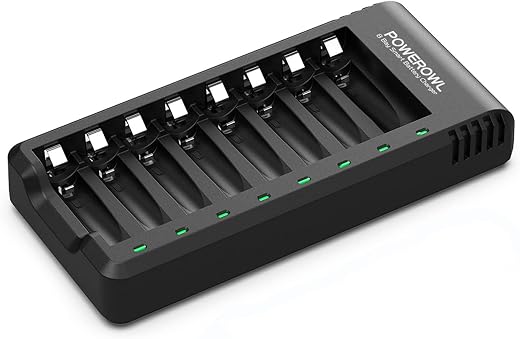
The POWEROWL battery charger is a fourteen-dollar answer to that problem, with eight independently controlled bays and USB power. It has more than 23,000 ratings at a 4.4-star average, making it one of the most-bought chargers on the market, and the price puts it in the category of purchase you barely think about. That combination is worth examining, because cheap chargers are also where corners get cut in ways that shorten battery life without you noticing.
Quick verdict: the POWEROWL battery charger scores 8.2/10 in this SoftPickr review. For the money it is hard to fault — eight independent bays, automatic cutoff and USB power cover what most households need, provided you accept it is a slow charger with no capacity readout.
Table of Contents

Key Specifications
| Feature | Specification |
|---|---|
| Bays | 8, independently controlled |
| Battery types | NiMH and NiCd, AA and AAA |
| Input | 5V USB (no adapter included) |
| Recommended supply | 5V/2A |
| Output voltage | 1.4V |
| Charge current | 250 mA per bay |
| Typical charge time | Around 10 hours for a full AA cell |
| Charge termination | Automatic cutoff with trickle top-up |
| Indicators | Per-bay LED |
| Dimensions | 6 x 3.1 x 1.1 inches |
| Weight | 5.6 ounces |
| Safety | US safety certified, chip-controlled charging |
Why Independent Bays Matter More Than Speed
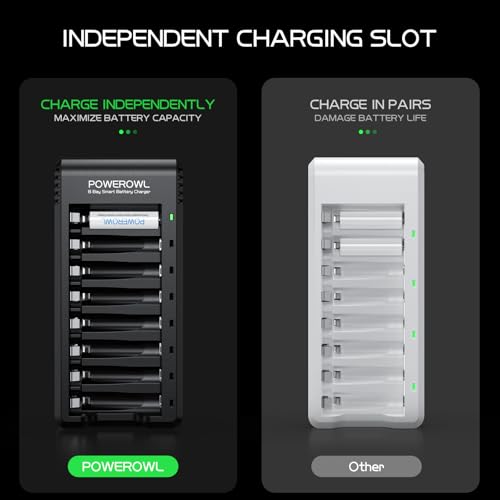
The single most useful thing about this charger is that each of the eight bays charges on its own. Older and cheaper designs wire bays in pairs, which means you must insert two batteries at a time, they must be the same type and roughly the same state of charge, and both stop when the pair is done. That arrangement is how a great many rechargeable cells get quietly ruined — a half-full battery paired with an empty one gets overcharged while the other catches up.
Here you can put in one AAA, or three AA and two AAA, or eight of anything in any mixture and any state, and each bay makes its own decision about when to stop. That is the difference between a charger you have to think about and one you can leave on a shelf and use without ceremony. At this price it is not a given, and it is the main reason to pick this over the very cheapest four-bay units.
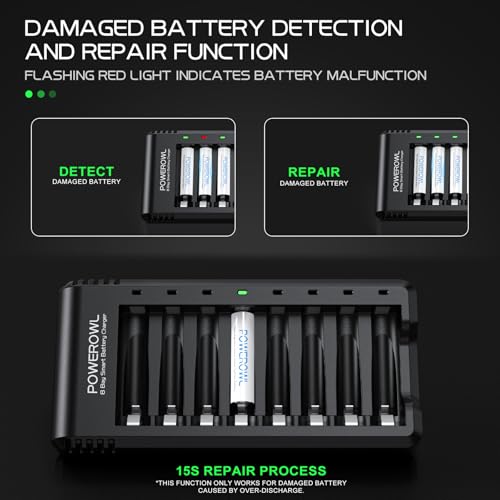
The per-bay LED tells you which slots are active and which have finished. It does not tell you capacity, health, or how much charge went in — this is a status light, not a display. That distinction matters for the buying decision and we come back to it below.
The Charging Regime: Slow on Purpose
Two hundred and fifty milliamps per bay is a low current, and a typical 2000 mAh AA cell will take the better part of ten hours to fill from empty. That is slow, and if you are used to fast phone charging it feels almost archaic. It is also, for NiMH chemistry, the kinder approach: low-current charging generates less heat, and heat is the primary thing that degrades rechargeable cells over their service life.
The charger terminates automatically when a cell reaches full and drops to a trickle to hold it there, which is the behaviour you want and which the very cheapest chargers do not implement properly. In practice this means you can leave batteries in overnight, or over a weekend, without cooking them. The cells come out warm rather than hot, which is the simplest field test of whether a charger is treating them well.
Where the slow rate bites is if you need batteries back in service quickly. A camera flash user shooting an event, or a household where the controller dies mid-game, will find ten hours intolerable. The workaround is the same one that makes rechargeables work generally: own two sets, and rotate. At the price of these cells that is a cheaper fix than buying a fast charger.
USB Power, and What Is Not in the Box
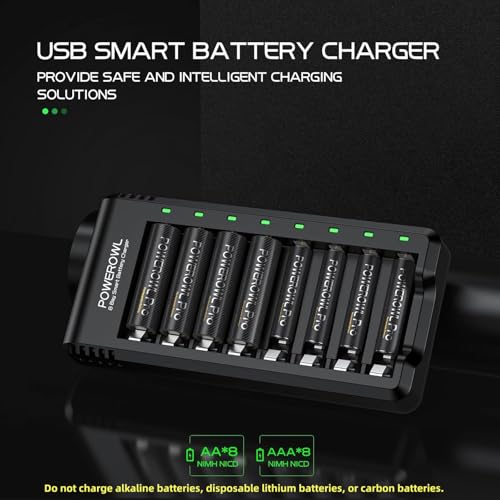
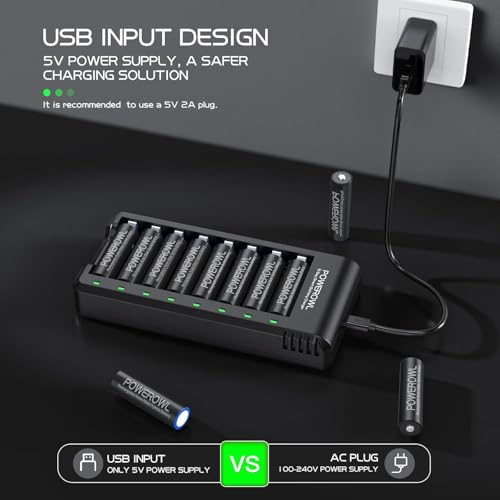
The charger takes 5V USB input and no wall adapter is included. That is a deliberate and increasingly sensible choice — most households already have a drawer of phone chargers, and it means the unit runs equally well from a laptop, a power bank or a car USB socket, which makes it genuinely portable in a way mains-only chargers are not.
The one thing to get right is the supply. POWEROWL recommends 5V/2A, and using a weak old 5V/0.5A phone charger will slow charging further or leave the outer bays underpowered when all eight are loaded. Any modern phone charger will be fine; a decade-old one from a drawer might not. This is the most common cause of a charger appearing to underperform, and it is not the charger fault.
Also not in the box: batteries. This is the charger alone, which is worth reading twice because several near-identical listings in the search results bundle cells and cost considerably more. If you already own rechargeables, buying the bare charger at fourteen dollars is the right move. If you do not, price a bundle before deciding.
Limitations and Compromises
The absence of any capacity or health readout is the meaningful functional gap. Better chargers show you the milliamp-hours delivered to each cell, which is how you identify a battery that has quietly lost half its capacity and is due for replacement. Without that, a dying cell in a set of four just makes the whole set seem unreliable, and you end up replacing all of them. If you own a lot of rechargeables and want to manage them properly, an analysing charger costs three to four times as much and is worth it.
The ten-hour charge time is the other compromise, and it is inherent to the gentle 250 mA approach rather than a defect. It suits a household that plans ahead and owns spare cells; it does not suit anyone who needs batteries back in service the same afternoon. There is also no discharge or refresh cycle here, so cells that have developed a memory effect from partial charging cannot be reconditioned — again, a feature reserved for more expensive units.
Safe Use and Battery Care
The one hard rule is chemistry: this charges NiMH and NiCd cells only. Putting alkaline batteries in a NiMH charger is genuinely dangerous, because alkalines are not designed to accept charge and can vent or rupture. Lithium AA cells are equally unsuitable. Check what you are inserting, particularly if the household has a mixed drawer, and label your rechargeables if there is any doubt.
Keep the contacts clean — a cotton bud with a little isopropyl alcohol on the bay springs once or twice a year prevents the intermittent contact that makes an LED flicker and a bay appear dead. Store cells at partial charge rather than flat if they will sit unused for months, and keep both charger and batteries out of direct sun and away from heat, since elevated temperature is what shortens NiMH life more than cycle count does. The unit itself needs nothing beyond keeping dust out of the bays.
Who Should Buy It?
- You have devices around the house that eat AA or AAA cells and you are still buying disposables for them.
- You already own rechargeable NiMH batteries and need a charger that will not mistreat them.
- You want to charge odd numbers and mixed sizes without thinking about pairing.
- You want a charger that runs from USB so it can travel or work from a power bank.
- You are happy to charge overnight rather than needing cells back within the hour.
Look elsewhere if you want to know the actual capacity of each cell — an analysing charger with a display costs three or four times as much and is the right tool for anyone managing a large battery collection. Skip it if you regularly need a fast turnaround, because ten hours at 250 mA is the design and no setting changes it, and skip it if you were expecting batteries in the box, since this is the bare charger only.
SoftPickr Verdict
The POWEROWL battery charger earns 8.2/10. At fourteen dollars with eight independent bays, automatic cutoff and USB input, this covers what the overwhelming majority of households actually need from a battery charger, and the gentle charge rate is better for cell longevity than the fast alternatives.
The one compromise is information: there is no capacity readout, no refresh cycle and no way to tell a healthy cell from a tired one. That is exactly what you would expect at this price, and it is why this takes our Best Price badge rather than a higher award — it is the cheapest charger we would happily recommend, not the best charger available.
Price and availability change frequently on Amazon, and prices shown here may be out of date — check the current listing before ordering.
POWEROWL battery charger — Frequently Asked Questions
Can it charge alkaline batteries?
No, and it should never be attempted. The POWEROWL battery charger is designed for NiMH and NiCd rechargeable cells only. Alkaline batteries are not built to accept a charge and can leak, vent or rupture in a charger. Lithium AA cells are also unsuitable. If your household has a mixed battery drawer, label the rechargeables clearly.
Why does it take ten hours to charge a battery?
It charges at 250 mA per bay, which is deliberately gentle. Low-current charging generates less heat, and heat is what degrades NiMH cells over time — batteries come out warm rather than hot. The practical answer to the wait is owning two sets and rotating them, which costs less than buying a fast charger.
Do I need a specific USB power supply?
A 5V/2A supply is recommended and any reasonably modern phone charger will do. A very old low-current adapter can leave the outer bays underpowered when all eight slots are loaded, which is the usual explanation when a charger seems to underperform. No adapter is included in the box.
Can I mix AA and AAA in the same session?
Yes. Each of the eight bays is independently controlled, so you can charge any mixture of AA and AAA in any state of charge, and each slot stops when its own cell is full. That is the main advantage over cheaper chargers that wire bays in pairs and require matched batteries.
Ready to buy? You can check the current price of the POWEROWL battery charger on Amazon — the listing shows live pricing and current stock, both of which move around more than the specification does. SoftPickr earns a commission on qualifying purchases at no extra cost to you.
Related Reviews
If the POWEROWL battery charger is not quite the right fit, these SoftPickr reviews cover the closest alternatives we have tested:
Additional information
Specification: POWEROWL Battery Charger Review — Best Cheap 8-Bay AA and AAA Charger?
|
Price History
| Price history for POWEROWL 8 Bay AA AAA Battery Charger, USB High-Speed Charging, Independent Slot, for Ni-MH Rechargeable Batteries, No Adapter | |
|---|---|
|
Latest updates:
|
|
There are no reviews yet.