
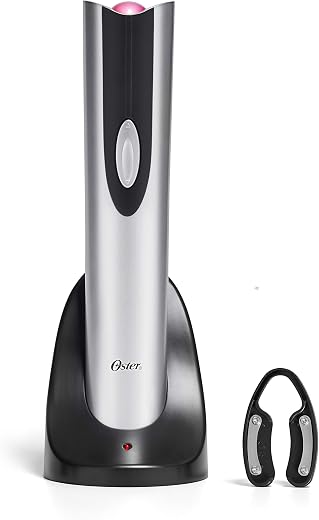


Oster Cordless Electric Wine Bottle Opener with Foil Cutter
Very few kitchen gadgets accumulate fifty thousand ratings. The ones that do are usually solving a problem that everyone has and nobody thinks about until their wrist starts complaining, and the electric corkscrew is exactly that. Push a button, wait four seconds, and the cork comes out vertically and intact – no leverage, no shoulder, no torn cork left in the neck of a bottle you were saving. It is the most-proven design in its category, and the only meaningful complaint is what happens when the battery finally goes.

$29.99
Description
Oster Electric Wine Opener Review: The Category Benchmark
Very few kitchen gadgets accumulate fifty thousand ratings. The ones that do are usually solving a problem that everyone has and nobody thinks about until their wrist starts complaining, and the electric corkscrew is exactly that. Push a button, wait four seconds, and the cork comes out vertically and intact – no leverage, no shoulder, no torn cork left in the neck of a bottle you were saving.
The Oster FPSTBW8207 has been the volume leader in this category for well over a decade, with more than 50,000 ratings at a 4.4-star average. That is not the highest score in this round, but it is by far the deepest evidence base, and a decade of continuous sale at a stable rating tells you something about a device that a specification sheet cannot.
Quick verdict: the Oster electric wine opener scores 8.5/10 in this SoftPickr review. it is the most-proven design in its category, and the only meaningful complaint is what happens when the battery finally goes.
Table of Contents

Key Specifications
| Feature | Specification |
|---|---|
| Type | Cordless electric corkscrew |
| Bottles per charge | Up to 30 |
| Charge time | 6 to 8 hours |
| Operation | Single push-button, automatic extraction |
| Foil cutter | Included, separate tool |
| Base | Recharging base included |
| Handle | Soft-grip finish |
| Power | UL approved for 110 to 120 V |
| Model | FPSTBW8207-S |
| Weight | 0.95 kg |
| Warranty | One year limited |
How It Pulls a Cork and Why That Matters
A manual corkscrew works by leverage, which means the force applied to the cork is never quite straight. That is why manual openers tear old corks, why they crumble dry ones, and why they are genuinely difficult for anyone with a weak grip or a sore wrist. An electric opener drives a helix straight down the axis of the cork and then reverses to lift it out along the same line, with no sideways force at any point.
The practical result is that corks come out whole far more often, including the fragile ones from older bottles that a waiter friend would approach nervously. The extraction takes about four seconds, the cork is ejected from the helix by reversing the motor again, and the whole cycle needs one hand and no bracing. For people with arthritis or reduced grip strength this is the difference between opening a bottle and asking someone else to.
Battery Life, Charging and the Base
Thirty bottles per charge against a six-to-eight-hour recharge is the specification, and in practice the number is conservative for most households. Thirty bottles is a month or two of normal use, or a single large party, and the failure mode people actually encounter is not running out mid-bottle but forgetting to charge it for six months and finding it flat.
The recharging base is the reason it does not get forgotten. The opener stands upright in it on a countertop, so charging is the default state rather than something you remember to do, and the base doubles as a stand that keeps the device visible and to hand. It is a small design decision that does a lot of work, and it is one of the reasons this model outlasted competitors that shipped with a cable and no cradle.
The Foil Cutter and Everyday Handling
A separate foil cutter is included and it is a genuinely useful inclusion rather than packaging filler. It sits over the neck, twists once, and removes the capsule cleanly – a job that otherwise means a knife and a slightly nervous moment. Because it is a separate piece it can be lost, and losing it is the most common minor annoyance in the review record, so it is worth keeping it in the same drawer or on the same base.
The body is a soft-grip plastic with enough diameter to hold comfortably and enough weight to feel deliberate. It stands about fifteen inches tall in its base, which is worth knowing if your counter sits under a low cabinet. Operation is one button, there is nothing to learn, and there are no settings, which for a device that does one job is exactly right.
Limitations and Compromises
The battery is the limitation, and it is a real one. It is not user-replaceable, so when the cell finally stops holding charge – typically after several years of use – the correct response is to replace the whole device rather than repair it. That is the single most common theme in the negative reviews, and it is the reason a 4.4-star average sits below what the design would otherwise earn.
It is also physically larger than people expect, and it is a countertop appliance rather than a drawer one. Fifteen inches of height in the base means it needs a spot, and households short on counter space will find it competing with things they use daily. Synthetic corks and very tight modern closures also give it more trouble than natural cork, occasionally needing a second press. Very tall bottles with unusually long necks can be awkward to seat squarely, and the opener needs to sit flat on the rim to start cleanly. None of these is a reason to avoid it, but they are the small frictions that stop a device that does one job from doing it perfectly every single time.
Cleaning and Maintenance
Wipe the helix and the neck grip with a damp cloth after use, particularly after older bottles where sediment and dried wine can build up on the spiral. Never run the body under a tap or put any part of it in a dishwasher – the motor housing is sealed against splashes, not immersion. Dried wine on the helix is the usual reason an opener starts gripping corks unevenly.
For battery health, leave it on its base as the default. Nickel-based and lithium cells alike prefer regular topping up to long flat periods, and a device that lives in a cupboard for eight months at zero charge is the one that dies early. If it is being stored for a season, charge it fully first and give it a top-up every couple of months. The base itself needs nothing beyond an occasional wipe, but it is worth checking that the contacts are clean, since a thin film of kitchen grease on the charging pins is a surprisingly common reason an opener appears to stop holding charge when the cell is actually fine.
Who Should Buy It?
- Anyone with arthritis, a weak grip or a wrist injury who still wants to open their own bottles.
- Households that open wine often enough for the counter space to be justified.
- Hosts who open several bottles in a row and do not want to work for each one.
- Buyers of older wine, where fragile corks defeat manual openers.
- Anyone who has torn a cork in half and does not want to do it again.
Look elsewhere if counter space is tight or if you open two bottles a year – a good waiter friend costs a fraction of this and lives in a drawer. Anyone who insists on repairable devices should also skip it, because the battery is sealed and the end of the battery is the end of the opener. Travellers and picnic buyers want a manual opener regardless.
SoftPickr Verdict
The Oster electric wine opener earns 8.5/10. Fifty thousand ratings held at 4.4 stars across more than a decade is the deepest evidence base of anything reviewed here, and it describes a device that has needed no reinvention. Straight-axis extraction, thirty bottles per charge, a recharging base that keeps it topped up by default, and an included foil cutter add up to the benchmark version of a simple idea. It takes our Best Seller badge for this round on volume and consistency alike.
The compromise is the sealed battery. When it goes, the opener goes with it, and no amount of care changes that. Judged as a device with a five-to-ten-year life rather than a permanent one, it is the easiest recommendation in this batch.
Price and availability change frequently on Amazon, and prices shown here may be out of date — check the current listing before ordering.
Oster electric wine opener — Frequently Asked Questions
How many bottles can it open on one charge?
Up to 30, with a full recharge taking six to eight hours. For most households that is a month or two of normal use, and the recharging base means it is usually topped up rather than run flat.
Can the battery be replaced when it wears out?
No. The cell is sealed inside the body and is not user-replaceable, so when it stops holding charge the device is replaced rather than repaired. This is the most common criticism in the long-run review record.
Does it come with a foil cutter?
Yes, as a separate tool that sits over the bottle neck and twists to remove the capsule. Because it is a separate piece it is easy to misplace, so it is worth storing it with the opener.
Does it handle synthetic corks?
Usually, but less confidently than natural cork. Very tight synthetic closures occasionally need a second press, and they are the one situation where a manual opener can still be quicker.
Ready to buy? You can check the current price of the Oster electric wine opener on Amazon — the listing shows live pricing and current stock, both of which move around more than the specification does. SoftPickr earns a commission on qualifying purchases at no extra cost to you.
Related Reviews
If the Oster electric wine opener is not quite the right fit, these SoftPickr reviews cover the closest alternatives we have tested:
Additional information
Specification: Oster Cordless Electric Wine Bottle Opener with Foil Cutter
|

There are no reviews yet.