
Narcissus Electric Knife Sharpener Review — Best Under $40?
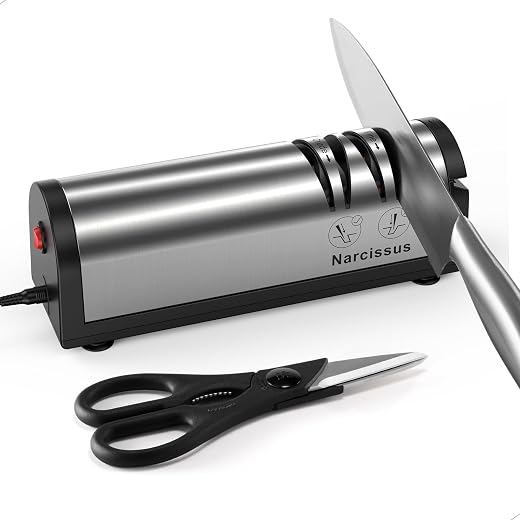
The Narcissus Knife Sharpener is a two-stage electric sharpener whose fixed guides remove the skill from knife sharpening: a coarse wheel reshapes a dull bevel and a fine wheel polishes the apex, taking a knife from useless to paper-cutting in under a minute. A block of six takes about five minutes. The cost of that convenience is steel — the wheels grind, the angle is not adjustable, and finer Japanese bevels will be permanently reprofiled.

$34.98
Description
Narcissus Knife Sharpener Review (2026) — Can a $35 Machine Restore a Dull Blade?
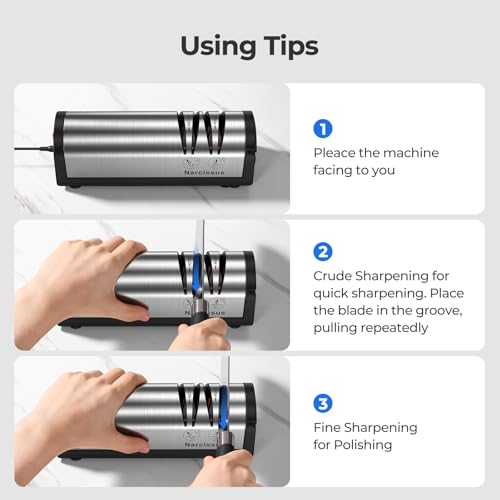
The Narcissus Knife Sharpener is a two-stage electric sharpener: a coarse slot with abrasive wheels that reshapes a damaged or badly dull edge, and a fine slot that hones and polishes it. You draw the blade through each slot a few times at the angle the guides hold for you, and a knife that could not cut a tomato skin will cut paper again within a minute.
We reviewed it because knife sharpening is the household task most people avoid — whetstones require practice, pull-through carbide sharpeners chew blades, and professional sharpening means finding someone who does it. The Narcissus Knife Sharpener’s real strength is that it removes the skill requirement entirely: the guides fix the angle, so the result is consistent whether or not you know what a bevel is. Its main compromise is the flip side of that convenience — abrasive wheels take real steel off, and a knife sharpened this way every week will not last as long as one honed on a stone.
Quick verdict: the Narcissus Knife Sharpener scores 8.1/10 in this SoftPickr review. It is the fastest way to make dull kitchen knives usable, and it is not the gentlest.
Table of Contents

Key Specifications
| Feature | Specification |
|---|---|
| Brand | Narcissus |
| Model Number | QN-M866 |
| Type | Two-stage electric knife sharpener |
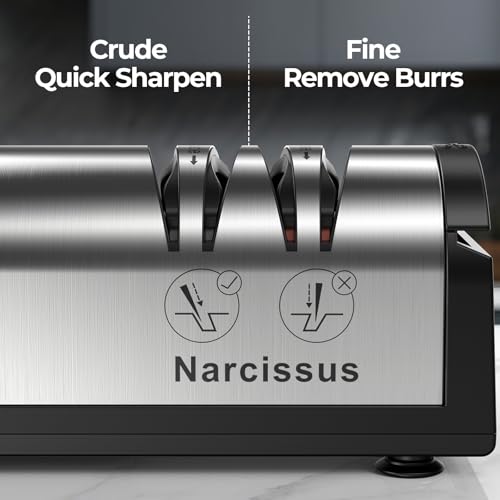
| Stage 1 | Coarse — reshapes and sharpens a dull or damaged edge |
| Stage 2 | Fine — hones and polishes the new edge |
| Abrasive Material | Carborundum |
| Grit Type | Fine (stage 2) |
| Angle Control | Fixed guides — no manual angle to hold |
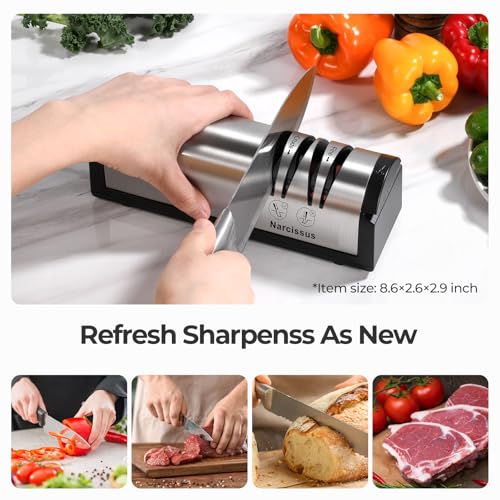
| Dimensions | 8.6"L x 2.6"W x 2.9"D |
| Weight | 1.6 lb |
| Colour | Silver |
| Included | Sharpener, adapter |
| Suitable For | Straight-edge kitchen and pocket knives |
| Amazon Rating | 4.4 / 5 from over 3,400 ratings |
Two Stages, and Why Both Matter
A sharp edge is two things: a correct geometry and a clean apex. The coarse stage does the first job — spinning abrasive wheels grind the bevel back to a consistent angle, removing the rolled, chipped or rounded metal that made the knife dull. On a badly neglected blade this is where almost all the work happens.
The fine stage does the second. Grinding leaves a burr and a rough scratch pattern, and running the blade through the fine slot removes the burr and polishes the bevel faces so they meet in a clean line. Skip it and the knife will feel sharp for a day and then fail, because a burr is not an edge — it is a thin flap of metal waiting to fold over.
The practical rule that gets the best from this machine is to use the coarse stage sparingly and the fine stage often. Most kitchen knives only need stage two, and reserving stage one for genuinely dull blades is what keeps the steel-removal cost down.
Fixed Angle Guides Do the Hard Part
The skill in freehand sharpening is holding a constant angle across the length of the blade, stroke after stroke. Most people cannot, which is why a first attempt on a whetstone usually produces a knife that is sharp in the middle and blunt at the heel and tip.
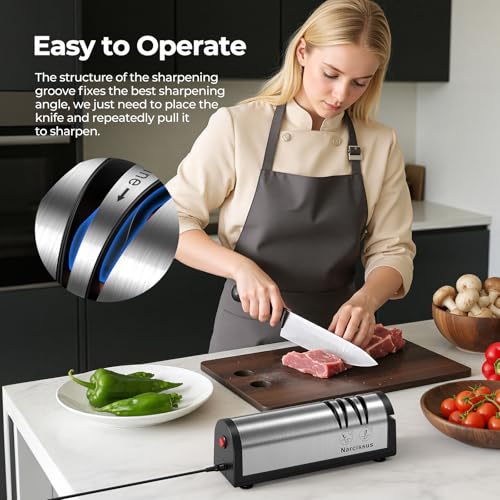
The guides here remove that variable entirely. The slot holds the blade at the designed angle and all you contribute is a steady pull-through at a steady speed. The result is uniform along the whole edge, which is the specific thing that makes a knife feel sharp in use rather than sharp in one spot.
The trade-off is that the angle is not yours to choose. A Japanese knife ground at 15 degrees per side put through a sharpener set for a Western 20 will be reground to the wider angle, losing the fine edge that made it a Japanese knife. That is a real consideration if your block contains anything expensive.
Speed, and What It Is Actually For
From dull to cutting paper is under a minute per knife, and a full block of six takes about five. That speed is the entire argument for owning one: sharpening stops being a project and becomes something you do while the pan heats up, which means it actually happens.
It is best understood as a maintenance appliance for working kitchen knives — the ones you use daily and replace every few years. Used that way it is excellent value. Used on heirloom carbon steel or a hand-forged gyuto it is the wrong tool, and no amount of care changes that.
Limitations and Compromises
It removes steel. Abrasive wheels are subtractive by definition, and a knife sharpened on this machine weekly will visibly narrow over a few years. For a $30 chef’s knife that is irrelevant; for a knife you intend to keep for decades it is not.
The angle is fixed. Knives ground to a finer Asian bevel will be reprofiled to the machine’s angle the first time through the coarse stage, and that change is permanent.
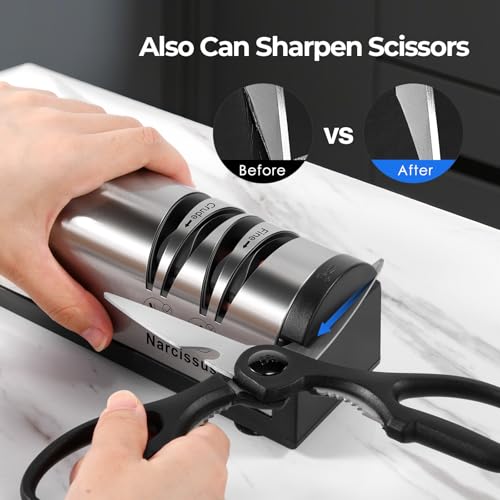
It is for straight edges only. Serrated bread knives, scalloped blades and ceramic knives should not go through it — serrations need a tapered rod and ceramic needs diamond.
There is no adjustment for blade thickness or wheel wear, so as the wheels age the results drift slightly. At this price there are no replacement wheels to fit, which effectively makes the sharpener a consumable itself.
It is an electrical appliance that lives in a cupboard, weighing 1.6 lb and taking up more room than the pocket sharpener it replaces.
Cleaning, Maintenance, or Setup
Setup is nothing more than plugging it in and setting it on a flat surface where it will not slide. Weight and rubber feet do most of the work, but a wet countertop undoes both, so dry the surface first.
Metal dust accumulates inside the slots and is the main maintenance item. Unplug it, turn it upside down over a bin and tap it out every few sessions. Never rinse it — water and abrasive dust make a paste that sets inside the housing.
Wipe the blade after sharpening. Grinding leaves fine metal particles on the steel that you do not want going into food, and a damp cloth followed by a dry one takes ten seconds.
Let the motor rest between knives if you are doing a whole block. It is a small motor with a light duty cycle and running six knives back to back without pause is the fastest way to shorten its life.
Who Should Buy It?
- Households with a block of mid-range Western kitchen knives used daily
- Anyone who has bought a whetstone, failed to get on with it, and gone back to blunt knives
- Cooks who want sharpening to take one minute rather than being an evening project
- People who currently use a pull-through carbide sharpener and want a genuinely better edge
- Anyone who has been paying for professional sharpening on inexpensive knives
Look elsewhere if your knives are Japanese, hand-forged, or otherwise expensive enough that the bevel angle matters to you — a whetstone and an hour of practice preserves both the geometry and the steel. Serrated and ceramic blades need dedicated tools this machine cannot provide, and if you only own two knives and sharpen twice a year, a good manual sharpener costs a third as much.
SoftPickr Verdict
The Narcissus Knife Sharpener earns 8.1/10. It solves the real problem with home knife sharpening, which is not equipment but skill: the fixed guides deliver a uniform edge along the whole blade without any technique at all, and the two-stage design means you get a polished apex rather than a burr. A block of six knives goes from dull to sharp in about five minutes.
The one compromise is that convenience is bought with steel. Abrasive wheels grind, the angle is not negotiable, and anything finer than a standard Western kitchen knife is better served elsewhere. For the working knives most kitchens actually contain, that is an easy trade.
Price and availability change frequently on Amazon, and prices shown here may be out of date — check the current listing before ordering.
Narcissus Knife Sharpener — Frequently Asked Questions
Will the Narcissus Knife Sharpener damage my knives?
It removes steel, which is how any abrasive sharpener works. Used on standard Western kitchen knives, with the coarse stage reserved for genuinely dull blades and the fine stage for routine touch-ups, the wear is negligible. Used weekly on the coarse stage, the Narcissus Knife Sharpener will visibly narrow a blade over a few years.
Can it sharpen serrated knives?
No. It is designed for straight edges only. Serrated bread knives need a tapered sharpening rod that fits inside each scallop, and ceramic blades need diamond abrasives. Putting either through this machine will damage the blade, the wheels, or both.
What is the difference between the two stages?
Stage one is coarse and reshapes the bevel, doing the heavy work on a dull or damaged edge. Stage two is fine and removes the burr that grinding leaves behind, polishing the bevel faces so they meet cleanly. Skipping stage two gives an edge that feels sharp for a day and then folds over.
Does it work on Japanese knives?
It will sharpen them, but it will also reprofile them. Japanese knives are typically ground at around 15 degrees per side and this machine’s guides are set for a wider Western angle, so the first pass through the coarse stage permanently changes the geometry. A whetstone is the correct tool for those knives.
Ready to buy? You can check the current price of the Narcissus Knife Sharpener on Amazon — the listing shows live pricing and current stock, both of which move around more than the specification does. SoftPickr earns a commission on qualifying purchases at no extra cost to you.
Related Reviews
If the Narcissus Knife Sharpener is not quite the right fit, these SoftPickr reviews cover the closest alternatives we have tested:
Additional information
Specification: Narcissus Electric Knife Sharpener Review — Best Under $40?
|


There are no reviews yet.