
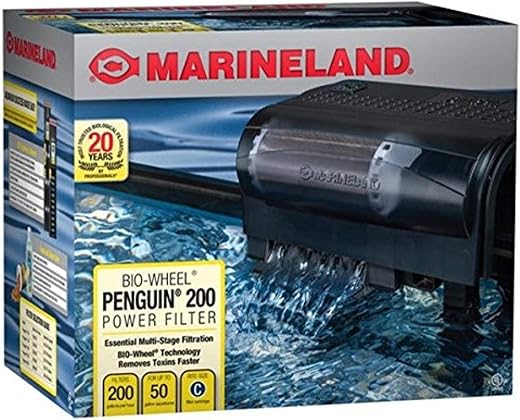


Marineland Penguin 200 Aquarium Filter — Bio-Wheel, 200 GPH
Aquarium filtration does three separate jobs and most buyers only think about one of them. Mechanical filtration catches visible debris, chemical filtration adsorbs dissolved compounds through carbon, and biological filtration hosts the bacteria colony that converts ammonia to nitrite and nitrite to nitrate. The third one keeps the fish alive, and it is the one a filter cartridge cannot do well. The biological filtration concept is genuinely sound and the mechanism that delivers it is the least reliable part of the filter.

$41.43
Description
Marineland Penguin 200 Review: A Design Idea That Divides Fishkeepers
Aquarium filtration does three separate jobs and most buyers only think about one of them. Mechanical filtration catches visible debris, chemical filtration adsorbs dissolved compounds through carbon, and biological filtration hosts the bacteria colony that converts ammonia to nitrite and nitrite to nitrate. The third one keeps the fish alive, and it is the one a filter cartridge cannot do well.
The Marineland Penguin has been sold for decades around a single idea aimed squarely at that third job, and it has accumulated more than 35,000 ratings in the process. It sits at 4.4 stars, which is good rather than commanding, and the gap between the concept and the reliability of the mechanism is the reason this review does not award a badge.
Quick verdict: the Marineland Penguin 200 scores 7.9/10 in this SoftPickr review. the biological filtration concept is genuinely sound and the mechanism that delivers it is the least reliable part of the filter.
Table of Contents
- Key Specifications
- What the Bio-Wheel Is Actually Doing
- The Rattle, and Why It Is the Main Complaint
- Sizing: 200 GPH Is Not a 20-Gallon Filter
- Cartridges, Carbon and the Ongoing Cost
- Limitations and Compromises
- Cleaning, Priming and Keeping the Wheel Turning
- Who Should Buy It?
- SoftPickr Verdict
- Frequently Asked Questions
- Related Reviews

Key Specifications
| Feature | Specification |
|---|---|
| Flow rate | 200 GPH |
| Filter type | Hang-on-back power filter |
| Biological media | Rotating bio-wheel |
| Suggested tank size | Up to 50 gallons |
| Cartridge type | Rite-Size penguin cartridge |
| Target species | Freshwater and marine fish |
| Weight | 2.3 lb |
| Model number | PF0200B |
| Manufacturer | Marineland |
| Number of packs | 1 |
| Included components | See label |
| Warranty | See label |
What the Bio-Wheel Is Actually Doing
Nitrifying bacteria need oxygen to work, and in a submerged filter media they compete for dissolved oxygen with everything else in the tank. The bio-wheel is a pleated wheel that sits half in the water flow and half in the air, turned by the returning water so that every part of its surface is alternately wetted and exposed to atmosphere many times a minute.
That arrangement gives the bacterial colony far better oxygen access than submerged media, which in principle supports a denser and more resilient colony in a smaller volume. It is a genuinely clever piece of engineering and the reason this filter line has survived for decades in a category where most designs are interchangeable.
The Rattle, and Why It Is the Main Complaint
The bio-wheel is driven by water flow alone and rides on a simple plastic axle. When it is clean and the flow is strong it turns smoothly and silently. When the axle collects mineral deposits, when flow drops because the cartridge is clogged, or when the wheel dries out during a power interruption, it slows, wobbles and rattles. In some cases it stops turning altogether.
A stopped bio-wheel is worse than an inconvenience. The bacterial colony living on it begins to die within hours of drying out, and a filter that has silently lost its biological capacity is a filter that is no longer protecting the fish. This is the failure mode that shapes the 4.4 rating, and it is the reason regular checking is not optional here.
Sizing: 200 GPH Is Not a 20-Gallon Filter
The naming is a trap. The Penguin 200 is rated at 200 gallons per hour and Marineland suggests it for tanks up to 50 gallons, not 20. The general guidance in fishkeeping is that a hang-on-back filter should turn over the tank volume roughly four to six times an hour, which puts 200 GPH at a 35 to 50 gallon tank.
Running it on a 20-gallon tank means turning the water over ten times an hour, which produces a current strong enough to visibly stress slow-moving or long-finned fish such as bettas and fancy goldfish. Marineland sells a Penguin 100 for smaller tanks. Buying the larger unit because the number resembles the tank size is a common and avoidable mistake.
Cartridges, Carbon and the Ongoing Cost
The Penguin uses proprietary Rite-Size cartridges combining a floss pad and activated carbon in one disposable unit. They are convenient and they are also the ongoing cost of ownership, at roughly $4 to $6 each with replacement suggested monthly. Over a year that is comparable to a meaningful fraction of the filter price.
Many experienced fishkeepers stop using the cartridges as designed. Carbon exhausts within weeks and mostly removes medications and odours rather than doing anything essential, while the floss pad hosts a share of the bacterial colony that gets thrown away at every change. Refilling the frame with sponge and ceramic media is a well-established route to lower running costs.
Limitations and Compromises
The bio-wheel mechanism is the single point of failure and the most common complaint across a very large rating base. It is driven only by water flow, rides on a plain plastic axle, and slows or stops when mineral deposits build, when flow drops, or after a power cut. A wheel that stops turning silently loses the bacterial colony that is the entire reason to buy this filter.
The listing is unusually empty for a product with 35,000 ratings. Included components reads See Label, the warranty description reads See Label, and item form is recorded as Power. There is no stated warranty period anywhere on the listing, which for a $41 appliance running unattended above an aquarium full of water is a fair thing to want in writing.
Replacing the cartridge as directed throws away part of the biological colony every month and commits the owner to a proprietary consumable at $4 to $6 a time. Buyers who follow the instructions exactly pay more and cycle their tank harder than those who repack the frame with sponge and ceramic media, which is an odd position for a filter sold on its biological performance.
Cleaning, Priming and Keeping the Wheel Turning
Never clean the bio-wheel in tap water. Chlorine and chloramine kill the bacterial colony that the wheel exists to host, and a wheel rinsed under the tap has been sterilised. If it needs cleaning, rinse it gently in water removed from the tank during a water change, and handle it as little as possible. The same applies to any sponge media in the frame.
Check the wheel is turning every few days, because a stopped wheel gives no other symptom. Clean the intake tube and impeller every few months, since a fouled impeller reduces flow and a reduced flow is what stalls the wheel. After any power cut, confirm the filter has primed and restarted rather than sitting full of stagnant water, which is when colonies are lost.
Who Should Buy It?
- Your tank is roughly 35 to 50 gallons and needs a hang-on-back filter.
- You want strong biological filtration in a compact external unit.
- You prefer a design with decades of track record over a newer alternative.
- You are willing to check the bio-wheel regularly rather than fitting and forgetting.
- You keep fish that tolerate or enjoy a reasonable current.
Look elsewhere if the tank is 20 gallons or smaller, where the Penguin 100 or an Aqueon QuietFlow is the correct size and this unit produces a current that stresses fish. Skip it if you keep bettas or fancy goldfish that dislike flow. And skip it if you want a sealed filter with no exposed moving part that can stall unnoticed.
SoftPickr Verdict
The Marineland Penguin 200 earns 7.9/10. No badge, and the reasoning is the mechanism rather than the idea. The bio-wheel gives nitrifying bacteria far better oxygen access than submerged media, which is genuinely good engineering, and 35,000 ratings across decades of sale show it works for a great many people. The concept is not in question.
What holds it back is that a flow-driven wheel on a plastic axle is the least robust part of the filter and the part everything else depends on. It slows, rattles and occasionally stops, and when it stops the biological capacity disappears without any visible warning. A badge should mean the obvious buy, and a filter that requires this much supervision is not.
Price and availability change frequently on Amazon, and prices shown here may be out of date — check the current listing before ordering.
Marineland Penguin 200 — Frequently Asked Questions
What size tank is the Marineland Penguin 200 designed for?
Marineland rates it for tanks up to 50 gallons at 200 gallons per hour. The common guidance is four to six tank turnovers per hour, which puts it at roughly 35 to 50 gallons. Despite the name, it is not a 20-gallon filter; running it on a small tank creates a current strong enough to stress many fish.
Why is my bio-wheel not spinning?
Usually reduced flow. A clogged cartridge, a fouled impeller or mineral buildup on the axle all slow the wheel until it stops. Clean the impeller and intake tube, replace or rinse the cartridge, and check the axle for deposits. A stopped wheel loses its bacterial colony within hours, so this is worth checking every few days.
Do I have to use the Marineland cartridges?
No. The proprietary Rite-Size cartridges are convenient but expensive at $4 to $6 monthly, and replacing them discards part of the bacterial colony each time. Many experienced fishkeepers repack the frame with sponge and ceramic media instead, which costs less over time and preserves more of the biological filtration between cleans.
Can I clean the bio-wheel under the tap?
Never. Chlorine and chloramine in tap water kill the nitrifying bacteria that live on the wheel, which is the entire point of the design. If it needs cleaning, rinse it in water siphoned out of the tank during a water change and handle it as little as possible. The same rule applies to any sponge media.
Ready to buy? You can check the current price of the Marineland Penguin 200 on Amazon — the listing shows live pricing and current stock, both of which move around more than the specification does. SoftPickr earns a commission on qualifying purchases at no extra cost to you.
Related Reviews
If the Marineland Penguin 200 is not quite the right fit, these SoftPickr reviews cover the closest alternatives we have tested:
Additional information
Specification: Marineland Penguin 200 Aquarium Filter — Bio-Wheel, 200 GPH
|
There are no reviews yet.