
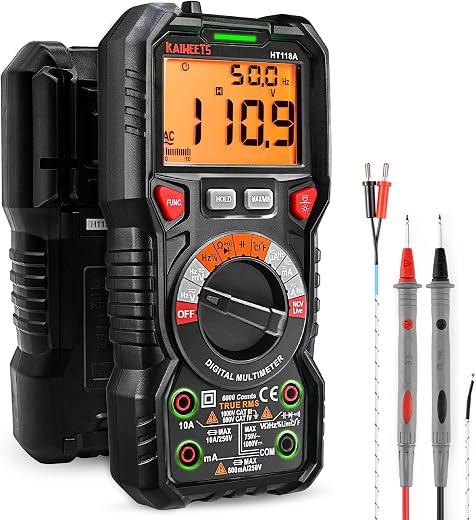


KAIWEETS HT118A Digital Multimeter — True RMS, 6000 Counts, Auto-Ranging
A multimeter is the tool that tells you whether the problem is the appliance, the socket or the fuse, and most households discover they need one about ten minutes after they needed one. The difficulty is that the category spans eight-dollar toys and four-hundred-dollar instruments that look broadly identical in a photograph. For domestic and automotive work it is more meter than most people will ever need.
Original price was: $41.99.$37.99Current price is: $37.99.
 Amazon.com
Original price was: $41.99.$37.99Current price is: $37.99.
Description
KAIWEETS Multimeter Review: Is the HT118A Enough Meter for Real Work?
A multimeter is the tool that tells you whether the problem is the appliance, the socket or the fuse, and most households discover they need one about ten minutes after they needed one. The difficulty is that the category spans eight-dollar toys and four-hundred-dollar instruments that look broadly identical in a photograph.
The KAIWEETS HT118A sits at $37.99 and carries 23,101 Amazon ratings averaging 4.6 stars, which is a serious evidence base for a test instrument. It offers true RMS measurement, 6,000 counts of resolution, auto-ranging and a thermocouple in the box. This review works out what those specifications mean in practice and which questions the listing does not answer.
Quick verdict: the KAIWEETS multimeter scores 8.4/10 in this SoftPickr review. For domestic and automotive work it is more meter than most people will ever need.
Table of Contents
Key Specifications
| Feature | Specification |
|---|---|
| Model | KAIWEETS HT118A |
| Display resolution | 6,000 counts |
| Measurement type | True RMS multimeter and voltmeter |
| Ranging | Auto-ranging |
| Measured quantities | Voltage, current, resistance, diodes, continuity, duty cycle, capacitance, temperature |
| Temperature range | Up to 1,000 °C with the supplied thermocouple |
| Standards | IEC and RoHS certified |
| Power | Battery powered, battery included |
| In the box | Meter, test leads, thermocouple, battery, manual |
| Dimensions | 8.03 x 5.12 x 2.44 inches |
| Weight | 0.55 kg |
| ASIN | B07SHLS639 |
True RMS Is the Specification That Matters
A cheap meter measures alternating current by assuming the waveform is a clean sine wave and applying a fixed correction. That assumption held in 1980 and does not hold in a modern house full of switch-mode power supplies, LED drivers, variable speed motors and inverter appliances, all of which distort the waveform badly. A non-RMS meter reads those loads wrong, sometimes by twenty per cent or more.
True RMS measurement calculates the actual heating value of whatever waveform is present, so the number on the screen is correct regardless of shape. It is the single most important feature separating a usable meter from a decorative one, and finding it at $37.99 alongside 23,101 ratings is the core of this product’s appeal.
6,000 Counts and Auto-Ranging
Counts describe display resolution. A 2,000-count meter jumps from 1.999 to 2.00, losing a decimal place exactly when a reading crosses a range boundary. Six thousand counts pushes that boundary further out, so you keep the extra digit across a wider span, and in practice that means reading 5.500 volts rather than 5.50 on a battery test where the third decimal is the whole point.
Auto-ranging removes the other classic beginner problem, which is selecting a range too low and reading an overload, or too high and reading nothing useful. The meter chooses for you and settles quickly. Experienced users occasionally prefer manual ranging for speed on repetitive measurements, and this is the one place where a more expensive instrument still has an argument.
The Function List Is Unusually Complete
Voltage, current, resistance, continuity and diode testing are the baseline that every meter offers. What lifts this one is what comes after: capacitance, duty cycle and temperature via a supplied thermocouple. Capacitance testing means you can check the run capacitor on a fan motor rather than replacing it speculatively, and duty cycle matters for anyone probing pulse-width signals in a car.
The thermocouple is the accessory people underrate. Being able to read the temperature of a bearing, a duct, a fridge compartment or a soldering iron tip turns a meter into a diagnostic tool for problems that are not electrical at all. It ships in the box rather than costing extra, which is worth noting in a category where accessories are usually where margin hides.
Build, Leads and the Case
At 0.55 kg with a chunky housing this feels like a working instrument rather than a pocket toy, and the size reflects it. It is a bench and toolbox meter, not something to slip into a shirt pocket. The supplied leads are adequate rather than excellent, which is normal at this price, and upgrading them is the cheapest meaningful improvement most owners make.
The IEC and RoHS certification stated in the listing tells you the meter has been built to recognised standards, and it is not the same thing as a stated CAT safety rating for a specific voltage environment. That distinction is covered in the limitations below, because it is the one place where a buyer could reasonably read more into the listing than it actually says.
Limitations and Compromises
The listing does not state a CAT safety category, and it quotes a maximum operating voltage figure of 80 volts in the specifications, which does not match a meter advertised for mains and automotive work. That inconsistency is in the source data rather than a judgement about the hardware, but it means anyone working on mains circuits should treat the safety envelope as unconfirmed rather than assuming a CAT III or CAT IV rating.
There is no stated basic accuracy percentage, which is the figure a technician would normally check first. For fault finding — is there voltage, is there continuity, is the capacitor dead — accuracy to a fraction of a per cent is irrelevant. For calibration work, or any measurement where the exact number matters legally or commercially, an unstated accuracy specification is a real gap.
Auto-ranging is slower than manual ranging on repetitive measurements, because the meter re-evaluates on each new reading. Anyone stepping through forty identical resistors will notice the delay. The HT118A does not offer a manual range hold in the specifications provided, and for most domestic and automotive use that is a non-issue, but it is the reason professionals still buy manual-capable meters.
Safe Use and Care
Check the test leads for nicks and cracked insulation before every session on anything mains-related, because leads fail long before meters do and they are the part between you and the circuit. Replacing them with a better-quality set is a cheap upgrade and the one most worth making.
Remove the battery if the meter will sit unused for months, since a leaking cell destroys more meters than misuse does. Store it away from damp, keep the thermocouple straight rather than coiled tightly, and turn the dial to off rather than leaving it in a current range, which is the position where an absent-minded probe of a live circuit does the most damage.
Who Should Buy It?
- Homeowners diagnosing dead sockets, failed appliances and suspect batteries.
- Car and motorcycle work, where duty cycle and temperature measurement both earn their keep.
- Anyone whose house is full of LED drivers and switch-mode supplies, which is where true RMS matters.
- Hobbyists working with electronics who need capacitance and diode testing as well as the basics.
- Buyers who want a thermocouple and leads in the box rather than as separate purchases.
Look elsewhere if you need a documented CAT III or CAT IV safety rating for professional mains work, because the listing does not state one and that is not a detail to assume. Skip it if you need a published accuracy specification for calibration or commercial measurement, and choose a manual-ranging meter instead if you spend your day stepping through many identical readings at speed.
SoftPickr Verdict
The KAIWEETS multimeter earns 8.4/10. The score reflects a meter that gets the important specification right — true RMS, which is what makes readings trustworthy in a modern house — and then adds 6,000 counts, auto-ranging, capacitance, duty cycle and a thermocouple for well under forty dollars. Twenty-three thousand ratings at 4.6 stars is a strong showing for a test instrument, where owners are unusually quick to complain.
The compromise is documentation rather than hardware. There is no stated CAT safety category, no published basic accuracy, and a maximum voltage field that does not match the meter’s advertised use. For domestic diagnosis and car work none of that matters much; for professional mains work it is exactly the information you should not have to guess at, and that is why this earns a strong score and no badge.
Price and availability change frequently on Amazon, and prices shown here may be out of date — check the current listing before ordering.
KAIWEETS multimeter — Frequently Asked Questions
What does true RMS mean and do I need it?
True RMS measures the real heating value of an alternating current waveform instead of assuming it is a clean sine wave. Modern homes are full of LED drivers, switch-mode power supplies and variable-speed motors that distort the waveform, and a non-RMS meter can read those loads wrong by a wide margin. If you are measuring anything other than a plain resistive load, yes, you need it.
Is the KAIWEETS HT118A safe for mains work?
The listing states IEC and RoHS certification but does not quote a CAT safety category, and its maximum operating voltage field reads 80 volts, which is inconsistent with a meter advertised for household and automotive use. Because we will not invent a rating that is not stated, treat the mains safety envelope as unconfirmed. For professional work on mains circuits, buy a meter with a documented CAT III or CAT IV rating.
What does 6000 counts give me over a cheaper meter?
Display resolution. A 2,000-count meter drops a decimal place as soon as a reading passes 1.999, so 2.00 volts loses the third digit exactly when you want it. Six thousand counts keeps that digit across a much wider span, which matters on battery testing, low-voltage sensor work and anything where a small change in the reading is the diagnosis.
What can I use the temperature probe for?
More than you would expect. The supplied thermocouple reads bearing and motor housing temperatures, duct and vent output, fridge and freezer compartments, soldering iron tips and engine components. It turns the meter into a diagnostic tool for problems that are mechanical rather than electrical, and it is included in the box rather than sold as an accessory.
Ready to buy? You can check the current price of the KAIWEETS multimeter on Amazon — the listing shows live pricing and current stock, both of which move around more than the specification does. SoftPickr earns a commission on qualifying purchases at no extra cost to you.
Related Reviews
If the KAIWEETS multimeter is not quite the right fit, these SoftPickr reviews cover the closest alternatives we have tested:
Additional information
Specification: KAIWEETS HT118A Digital Multimeter — True RMS, 6000 Counts, Auto-Ranging
|
There are no reviews yet.