
APC BX1500M UPS Battery Backup — 1500VA / 900W, 10 Outlets, LCD, AVR
An uninterruptible power supply is one of the few pieces of computer hardware whose entire value is measured in events that do not happen. It is not going to make anything faster. It exists so that a brownout during a thunderstorm does not corrupt a filesystem, a NAS does not lose an array rebuild halfway through, and a desktop with an hour of unsaved work does not simply stop existing. That is a hard thing to feel good about spending $190 on until the first time it earns it. It does the job it is sold for reliably, and almost everyone overestimates how long it will keep their equipment alive.

$189.99
Description
APC BX1500M — What 1500VA Actually Gets You When the Lights Go Out
An uninterruptible power supply is one of the few pieces of computer hardware whose entire value is measured in events that do not happen. It is not going to make anything faster. It exists so that a brownout during a thunderstorm does not corrupt a filesystem, a NAS does not lose an array rebuild halfway through, and a desktop with an hour of unsaved work does not simply stop existing. That is a hard thing to feel good about spending $190 on until the first time it earns it.
The BX1500M is the volume seller in APC Back-UPS line, and with 12,998 ratings at 4.4 stars it is one of the most bought UPS units on the market. It is also routinely misunderstood, because the two numbers on the box — 1500VA and 900W — describe very different things, and the runtime figures published for it disagree with each other by a factor of fifteen.
Quick verdict: the APC UPS battery backup scores 8.4/10 in this SoftPickr review. It does the job it is sold for reliably, and almost everyone overestimates how long it will keep their equipment alive.
Table of Contents
- Key Specifications
- 1500VA and 900W Are Not the Same Number
- AVR Is the Feature That Runs Every Day
- Real Runtime Is Minutes, Not Hours
- Simulated Sine Wave and What It Cannot Run
- Limitations and Compromises
- Battery Life, Self-Test and Replacement
- Who Should Buy It?
- SoftPickr Verdict
- Frequently Asked Questions
- Related Reviews

Key Specifications
| Feature | Specification |
|---|---|
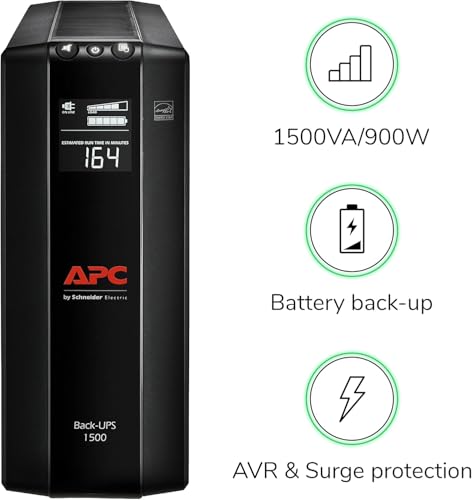
| Capacity | 1500VA / 900W |
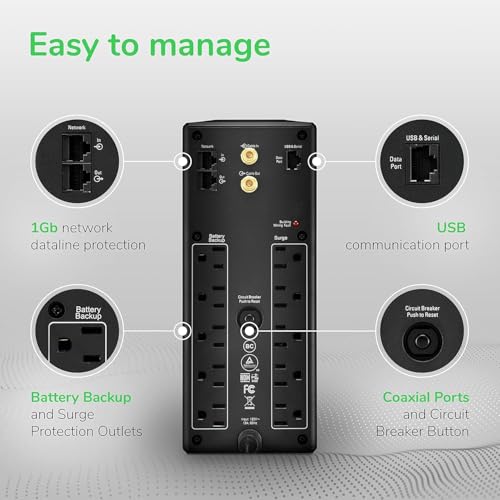
| Outlets | 10 total (battery backup + surge, and surge-only) |
| Voltage regulation | AVR — corrects brownouts and overvoltage without using battery |
| Waveform | Stepped approximation to a sine wave |
| Battery type | Sealed lead acid, user replaceable |
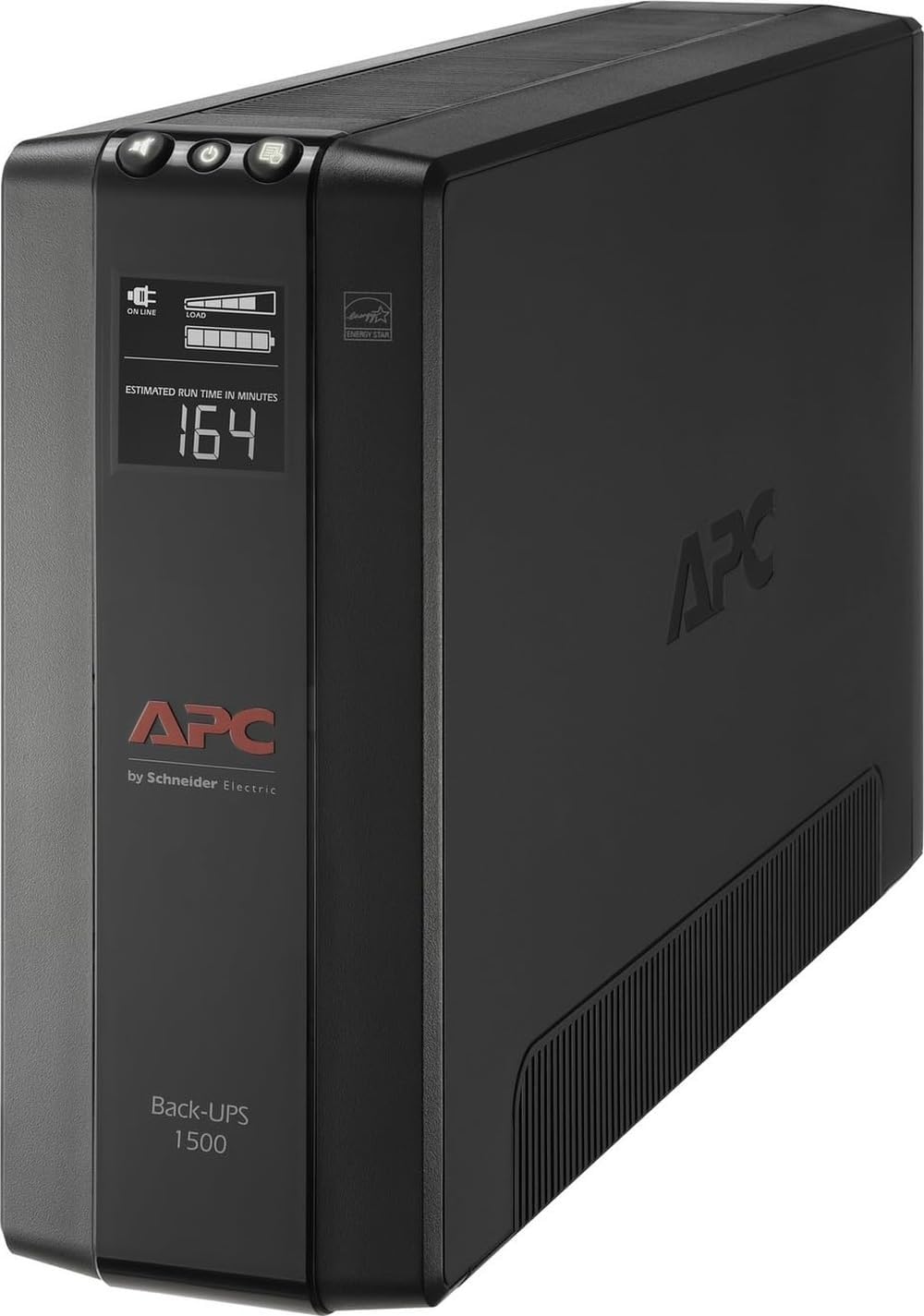
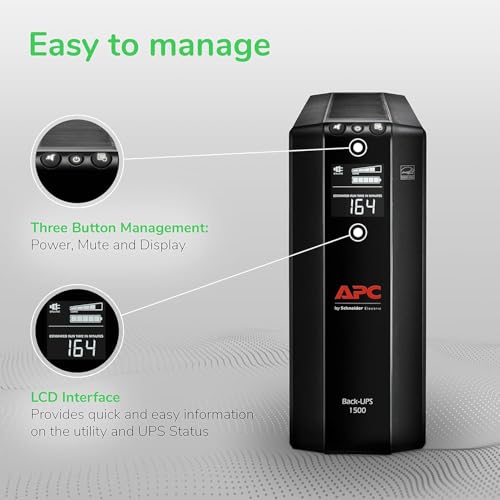
| Display | LCD status panel |
| Data connection | USB (PowerChute software) |
| Additional protection | Coaxial line surge protection |
| Input / output | 120 V, NEMA 5-15P cord, NEMA 5-15R outlets |
| Dimensions | 15.04 in D x 3.94 in W x 9.84 in H |
| Weight | 24.2 lb |
| Warranty | 3 years |
1500VA and 900W Are Not the Same Number
Volt-amps measure apparent power and watts measure real power, and the ratio between them is the power factor of whatever you plug in. APC prints the larger figure on the front of the box because it is the larger figure. The one that constrains you is 900 W, and modern computer power supplies with active power factor correction draw close to their full wattage in real terms, so the VA rating gives you almost no headroom over the watt rating in practice.
What that means concretely is that a gaming desktop pulling 400 W under load, a 27-inch monitor at 40 W and a router at 15 W leave you comfortably inside the envelope. The same unit will not carry a workstation with a 750 W supply running flat out, and it should never be asked to carry a laser printer, whose warm-up surge will trip it instantly.
AVR Is the Feature That Runs Every Day
Automatic voltage regulation is the part of this unit that does something continuously rather than during outages. When mains voltage sags — which happens whenever a large motor starts nearby, an air conditioner cycles, or the grid is under load — AVR boosts it back into range using a transformer tap rather than switching to battery. Overvoltage is trimmed the same way.
This matters because the battery is a wear item with a finite number of cycles, and a UPS without AVR burns one of those cycles every time the voltage dips. In an area with soft mains, that can mean several transfers a day and a battery that dies in eighteen months. With AVR the battery sits idle and is preserved for actual outages, which is why it is worth having even where power cuts are rare.
Real Runtime Is Minutes, Not Hours
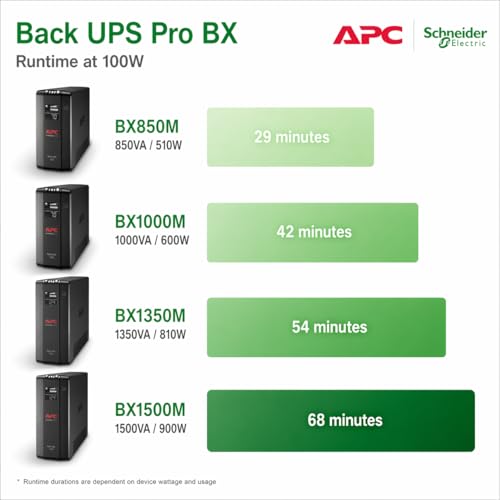
The listing publishes three different runtime figures: a Battery Average Life of 19 minutes, a Runtime of 5 hours, and an Item Highlight claiming 68 minutes. Only the first of those is in a plausible range for a real load. A UPS this size holds a typical desktop and monitor for roughly five to ten minutes, and holds a modem, router and NAS for perhaps forty-five.
That is not a failing — it is what the category is for. A UPS is a bridge that lets equipment shut down cleanly or ride out the sub-minute flickers that make up the vast majority of power events. If you want to keep working through a two-hour outage you need a generator or a large portable power station, and no UPS at this price is going to do it.
Simulated Sine Wave and What It Cannot Run
The BX1500M outputs a stepped approximation to a sine wave rather than a true sine wave, which is the main technical distinction between this unit and the more expensive BR and Smart-UPS lines. For most equipment it is completely fine — switching power supplies rectify the input immediately and do not care about the shape of the waveform.
The exception is any load with an active power factor corrected supply that is fussy about zero crossings, and some motorised or audio equipment. In practice the symptom is a device that buzzes, runs hot, or refuses to transfer to battery at all. If you are protecting a high-end workstation, a home audio amplifier or medical equipment, the pure sine wave models exist for exactly this reason and are worth the extra outlay.
Limitations and Compromises
The battery is a sealed lead acid cell and it will die, typically in three to five years, sooner in a warm room. When it does, the unit beeps continuously and the LCD reports a fault, and until it is replaced you have an expensive surge protector. The cartridge is user replaceable and reasonably priced, but nothing about the product tells you the replacement clock is running, and a great many of these units are quietly non-functional in the field.
The published specification is internally inconsistent to a degree that is genuinely unhelpful. Three incompatible runtime figures appear in the same listing. The Item Highlight describes the product as a “Back-UPS Pro 1500VA”, which is a different and more expensive model line — the BX1500M is not a Pro. Enclosure Material is listed twice. The only figures we would rely on are 1500VA, 900 W, ten outlets and the 3-year warranty.
At 24.2 lb this is a heavy object with a 15-inch depth, and it is not designed to be seen. It sits on the floor under a desk, its cord is short enough that placement is constrained, and the ten outlets are spaced closely enough that two large wall-wart adapters will block their neighbours. There is no rack mount option and no way to make it look like anything other than what it is.
Battery Life, Self-Test and Replacement
Run the self-test occasionally and watch the LCD. The unit performs an automatic test periodically and will report a battery fault when the cell can no longer hold charge, but the warning is easy to miss if the UPS lives under a desk with the beeper muted. Put a reminder in a calendar for the three-year mark and check it deliberately, because the failure is silent until you need the thing.
Keep it off carpet and away from heat. Lead acid battery life halves for roughly every 15 F above room temperature, so a UPS tucked into a warm cabinet next to a games console will not reach three years. Leave a few inches of clearance around the vents, do not stack anything on top of it, and when the battery does go, replace the cartridge rather than the unit — the electronics typically outlast three or four batteries.
Who Should Buy It?
- Desktop users with unsaved work who need a clean shutdown rather than an abrupt one.
- Anyone running a NAS or home server where an interrupted write can cost an array.
- Households in areas with soft mains voltage, where AVR runs constantly and earns its keep.
- Home offices that need a modem and router to stay alive through short outages.
- Buyers who want a user-replaceable battery and a three-year warranty from an established brand.
Look elsewhere if you need to keep working through a long outage rather than shut down safely — a portable power station or a generator is the right category, and no UPS at this price competes. If you are protecting a high-end workstation, audio equipment or anything sensitive to waveform shape, step up to a pure sine wave model. And if all you own is a laptop, its own battery already does this job and a plain surge protector will cover the peripherals.
SoftPickr Verdict
The APC UPS battery backup earns 8.4/10. It is the sensible default in its category: enough capacity for a desktop and monitor, AVR that protects the battery from everyday voltage sag, ten outlets, a user-replaceable cell and a three-year warranty, at a price that does not make you think hard about it.
The compromise is the waveform and the honesty of the runtime. This is a simulated sine wave unit, which rules out a narrow but real set of sensitive equipment, and it will hold a typical desktop for five to ten minutes rather than the hour its own listing implies. Bought as a clean-shutdown bridge it is excellent value. Bought as a way to keep working through an outage, it will disappoint within the first ten minutes.
Price and availability change frequently on Amazon, and prices shown here may be out of date — check the current listing before ordering.
APC UPS battery backup — Frequently Asked Questions
How long will the APC BX1500M actually run a desktop PC?
Realistically five to ten minutes with a mid-range desktop and one monitor, and rather less with a gaming machine under load. A low-draw setup such as a modem, router and NAS can stretch to forty-five minutes or more. The 5-hour and 68-minute figures in the listing do not describe any plausible real load.
What is the difference between 1500VA and 900W?
Volt-amps are apparent power and watts are real power. The 900 W figure is the one that limits you, because modern power supplies with active power factor correction draw close to their full wattage in real terms. Size your load against 900 W and treat 1500VA as a marketing number.
Can you replace the battery yourself?
Yes. The BX1500M uses a standard replaceable sealed lead acid cartridge, accessible without tools on most units, and replacements are inexpensive and widely stocked. Expect to need one every three to five years, sooner if the unit lives somewhere warm. The electronics generally outlast several batteries.
Is a simulated sine wave a problem?
For the great majority of equipment, no — switching power supplies rectify the input immediately and are indifferent to waveform shape. The exceptions are some active PFC supplies, motorised loads and audio equipment, which may buzz, run warm or refuse to transfer. If you are protecting anything in that group, buy a pure sine wave model instead.
Ready to buy? You can check the current price of the APC UPS battery backup on Amazon — the listing shows live pricing and current stock, both of which move around more than the specification does. SoftPickr earns a commission on qualifying purchases at no extra cost to you.
Related Reviews
If the APC UPS battery backup is not quite the right fit, these SoftPickr reviews cover the closest alternatives we have tested:
Additional information
Specification: APC BX1500M UPS Battery Backup — 1500VA / 900W, 10 Outlets, LCD, AVR
|
There are no reviews yet.