


Kerilyn Deep Fryer Pot Review — Does Japanese Tempura Style Work at Home?
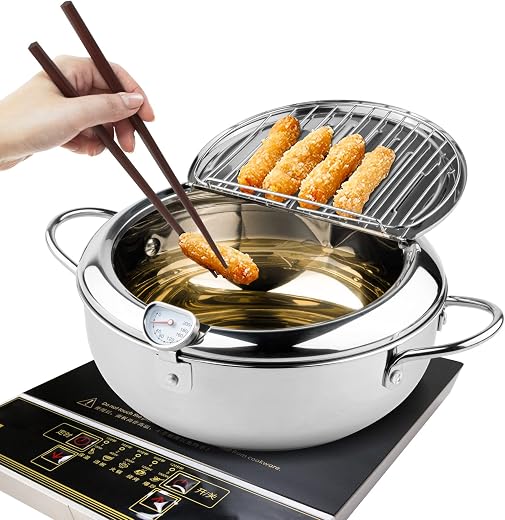
Most people who want to fry at home reach for an electric deep fryer, and most of those end up in a cupboard within a year. They are bulky, they hold two or three litres of oil that has to be dealt with, and the thermostats in the affordable ones are famously vague. The Japanese approach is different: a small, tall, heavy stainless pot on the hob, a clip-on thermometer, and a lid that doubles as a drain rack. A well-made small pot that makes home frying far less daunting, let down by a thermometer that is indicative rather than accurate and a capacity that limits you to small batches.
 Amazon.com
Description
Kerilyn Deep Fryer Pot Review — The Case for Frying in a Small Pot Instead of an Appliance
Most people who want to fry at home reach for an electric deep fryer, and most of those end up in a cupboard within a year. They are bulky, they hold two or three litres of oil that has to be dealt with, and the thermostats in the affordable ones are famously vague. The Japanese approach is different: a small, tall, heavy stainless pot on the hob, a clip-on thermometer, and a lid that doubles as a drain rack.
The Kerilyn deep fryer pot is a well-priced version of that idea at 9.4 inches across and 3.4 litres, made from 304 stainless and rated for induction as well as gas and electric. It sits at 4.3 stars across just over 2,000 ratings, which is respectable rather than outstanding, and the pattern in those ratings tells you a lot about who this suits. We wanted to work out where the honest boundary sits between this and a proper appliance.
Quick verdict: the Kerilyn deep fryer pot scores 7.7/10 in this SoftPickr review. A well-made small pot that makes home frying far less daunting, let down by a thermometer that is indicative rather than accurate and a capacity that limits you to small batches.
Table of Contents
Key Specifications
| Feature | Specification |
|---|---|
| Diameter | 9.4 inches |
| Capacity | 3.4 litres |
| Material | 304 stainless steel |
| Dimensions | 9.5 x 9.5 x 4.7 inches |
| Weight | 2.6 pounds |
| Thermometer | Clip-mounted analogue dial, included |
| Lid | Included — doubles as a draining surface |
| Drain rack | Removable oil drip rack that hooks on the rim |
| Hob compatibility | Induction, gas, electric and ceramic |
| Pouring | Beak-shaped diversion port for returning oil to a container |
| Colour | Silver |
| Dishwasher safe | Yes, though hand washing is recommended |
Why a Small Pot Beats a Big One
The instinct when buying a frying vessel is to go large, and it is the wrong instinct. A 3.4-litre pot needs roughly a litre and a half of oil to reach a usable depth, against three or more litres in a typical electric fryer. That difference determines almost everything downstream: how much oil you buy, how long it takes to come up to temperature, how much you have to store or discard afterwards, and how much you flinch at the idea of frying on a Tuesday.
The tall, narrow profile matters as much as the volume. Deep, narrow vessels lose less heat from the surface and recover temperature faster when cold food goes in, which is the single biggest determinant of whether fried food comes out crisp or greasy. A wide shallow pan drops thirty or forty degrees the moment a batch hits it and takes an age to climb back. This shape recovers quickly, and with a litre and a half of oil rather than three you are also heating far less mass to get there.
The 304 stainless is the right grade — it is the standard food-contact austenitic stainless, it does not react with anything, and it takes the thermal cycling of frying without warping. At 2.6 pounds this is not a heavy-gauge pan and it will not hold heat like cast iron, but it heats fast, which for oil is the more useful property.
The Lid, the Rack and the Pouring Spout
Three details lift this above a plain saucepan. The first is the drain rack, which hooks over the rim so fried food sits above the oil and drips back into the pot instead of onto kitchen paper. That keeps the food crisper — steam escapes rather than being trapped against paper — and it wastes less oil.
The second is the lid, which is designed to be inverted and used as a draining and resting surface. It is a neat piece of dual-purpose thinking and it works, though it also means the lid is in use rather than on the pot at exactly the moment you might want it on the pot. That is a real trade rather than a flaw.
The third is the beak-shaped pouring port on the rim, which exists so you can return used oil to a bottle without it running down the outside of the pan. Anyone who has tried to decant hot oil from a straight-rimmed pot will understand why this is worth mentioning. It is not perfect — pour slowly and it is clean, pour fast and it still dribbles — but it is a great deal better than nothing.
Temperature Control: Where the Compromise Lives
The clip-on analogue thermometer is the weakest part of the package, and it is the reason this scores where it does. Analogue dial thermometers in this price bracket are typically accurate to within perhaps ten or fifteen degrees Fahrenheit, they respond slowly, and where the probe sits in the oil changes the reading. For frying, where the difference between 340°F and 375°F is the difference between soggy and burnt, that is a meaningful margin.
In practice it works as an indicator rather than an instrument. It will tell you reliably that the oil is hot enough to start and that it has dropped after a batch, and that is genuinely useful. It will not let you hold a precise temperature the way an instant-read digital probe will, and the manufacturer note that adding too much food at once drops the temperature is doing some quiet work in the listing — that is true of all frying, but it matters more when your instrument is imprecise.
The fix is cheap. Any digital instant-read thermometer, including the kind most kitchens already own for meat, gives a far better reading in two seconds. If you are buying this pot, budget for that too and treat the included dial as a rough guide.
Limitations and Compromises
Capacity is the honest ceiling. Three and a half litres of pot with a litre and a half of oil in it will fry two portions of chips, a handful of chicken pieces or a batch of tempura — and then it needs a few minutes to recover before the next batch. Cooking for four means working in shifts and keeping the first batch warm in the oven, which is entirely workable but is not what people picture when they imagine deep frying at home. Anyone regularly feeding a family should size up.
The thermometer is the other compromise, and it is a design decision rather than a defect. An analogue dial at this price gives you a general sense of the oil temperature and nothing more precise, which is enough to fry safely but not enough to fry consistently. Buyers who expect appliance-grade thermostatic control will be disappointed; buyers who already own a digital probe will not notice.
Cleaning and Oil Handling
Let the oil cool completely before touching anything — this is not a suggestion, and moving a pot of hot oil is by some distance the most dangerous thing that happens in a domestic kitchen. Once cool, pour it back through a fine sieve or a coffee filter into a sealable bottle using the beak port. Filtered oil keeps for several rounds of frying; unfiltered oil carries food particles that burn on the next heat and give everything an off taste. Never pour oil down a drain.
The pot itself is dishwasher safe but hand washing keeps the finish better. Hot water with a little dish soap and a soft sponge takes off almost all of it, and for the tacky polymerised film that builds up around the rim over time, a paste of bicarbonate of soda and a few minutes of patience works without scratching. Avoid steel wool and abrasive powders on 304 stainless — they leave micro-scratches that catch residue and make the next clean harder.
Who Should Buy It?
- You fry occasionally and want to do it properly without dedicating a cupboard to an appliance.
- You are cooking for one or two people, where batch size is not a constraint.
- You want to use less oil per session and store what you keep.
- You have an induction hob, which rules out many cheaper aluminium fryers.
- You already own a digital instant-read thermometer, or are willing to buy one.
Look elsewhere if you fry for a family regularly, because 3.4 litres means working in batches and reheating between them. Skip it if precise temperature control matters to you and you do not want to buy a separate digital thermometer, since the included dial is indicative at best, and skip it altogether if you want the set-and-forget convenience of a thermostatic electric fryer — this is a hob pot and it needs your attention the whole time it is hot.
SoftPickr Verdict
The Kerilyn deep fryer pot earns 7.7/10. As a piece of cookware it is well judged: the right grade of steel, the right proportions for heat recovery, and three genuinely useful details in the rack, the lid and the pouring port.
The one compromise is the thermometer, which is an indicator rather than an instrument and puts a ceiling on how consistently you can fry with it out of the box. That is why it takes no badge here despite a fair 4.3-star average over 2,000-plus ratings — it is a good pot with a mediocre accessory attached, and the fix costs another fifteen dollars.
Price and availability change frequently on Amazon, and prices shown here may be out of date — check the current listing before ordering.
Kerilyn deep fryer pot — Frequently Asked Questions
How much oil does it actually need?
Around a litre and a half gives a usable frying depth in the 3.4-litre body, which is roughly half what a typical electric deep fryer requires. That is the main practical advantage of the Kerilyn deep fryer pot — less oil to buy, less to heat, less to filter and store afterwards, and a much lower barrier to frying on a weeknight.
Is the included thermometer accurate?
It is indicative rather than precise. Analogue dial thermometers at this price are typically within ten to fifteen degrees Fahrenheit and respond slowly, which is fine for knowing when the oil is ready and not enough for holding a target temperature. A digital instant-read probe costs very little and solves it completely.
Does it work on an induction hob?
Yes. The 304 stainless construction is induction compatible, and it also works on gas, electric and ceramic. That is worth noting because a number of cheaper tempura pots are aluminium and will not work on induction at all, which is one of the more common mismatches in this category.
How many portions can it fry at once?
Realistically two — a couple of servings of chips, a small batch of tempura, or a few pieces of chicken. Overloading it drops the oil temperature sharply and gives you greasy results, so for four people you are frying in shifts and holding the first batch in a warm oven.
Ready to buy? You can check the current price of the Kerilyn deep fryer pot on Amazon — the listing shows live pricing and current stock, both of which move around more than the specification does. SoftPickr earns a commission on qualifying purchases at no extra cost to you.
Related Reviews
If the Kerilyn deep fryer pot is not quite the right fit, these SoftPickr reviews cover the closest alternatives we have tested:
Additional information
Specification: Kerilyn Deep Fryer Pot Review — Does Japanese Tempura Style Work at Home?
|
There are no reviews yet.